When Tony Wang opened The Cat Cafe in San Diego in 2015, entry was free if you bought a drink. People bought one coffee and stayed all afternoon. The cafe soon switched to an hourly admission fee, and Wang has since called not charging one from the start the biggest mistake the business made. A decade later the cafe is still open, and he describes it as profitable.
Most of what makes a cat cafe work, or fail, is that kind of detail: how you charge, who pays the vet bills, whether the health department will let food and cats share a building, and whether a landlord will rent to you at all. There is no universal budget or permit checklist, because the rules are set city by city and the costs vary as much as rents do. What follows is what real cafes have reported, with sources, plus what the 1,163 open cat cafes in our directory tell us about how the business is run. None of it is legal or financial advice. Your local health department, licensing office and an accountant have the final word.
Choose Your Model First
Every other decision depends on where your cats come from and who is responsible for them. Cat cafes follow three main models.
Model | Who owns the cats | Adoption fees | Examples |
|---|---|---|---|
Rescue partner | A separate shelter or rescue, which usually handles vet care and screens adopters | Usually go to the rescue | Purrfect Day Café, Mew Haven, Orlando Cat Café |
Nonprofit cafe | The cafe itself is the rescue, usually a 501(c)(3) | Kept by the cafe | Cat Town, Mini Cat Town, Tree House |
Resident cats | The cafe, and the cats live there for good | None | A Sanctuary Cafe, most cafes in Japan |
The rescue partner model is the most common in North America. At least 59% of the open cafes in our directory offer their cats for adoption, usually with a local rescue or shelter. The cafe runs the coffee bar and the lounge, and the rescue supplies the cats, pays for routine vet care and approves adopters. Purrfect Day Café in Louisville works with the Kentucky Humane Society, which handles intake and medical care and sends staff in most days. In August 2024 it reached 10,000 adoptions. Mew Haven Cat Café, which hosts cats from Halfway Home Rescue, has placed more than 1,250 since opening in 2018. Partners differ on who pays when a cat gets seriously ill. At Catoro in Vancouver, the rescue covers routine care but the cafe pays for serious cases, and one cat with FIP ran up about $10,000 in bills. Agree on this in writing before the first cat arrives.
The nonprofit model turns the cafe into the rescue. Cat Town in Oakland, which opened the first US cat cafe in 2014, takes the cats at highest risk from Oakland Animal Services, and a coffee company runs the cafe counter. Its finances show how different nonprofits can be. In 2024 Cat Town brought in $1.31 million, almost all of it donations, with just $51,397 from programs, according to its tax filing. Mini Cat Town, a chain of kitten lounges in the Bay Area, brought in $2.1 million the same year, and $1.95 million of it came from programs, mostly admissions. A nonprofit can apply for grants. Cat Town expanded with a $162,500 grant from Maddie’s Fund. It also takes on the paperwork and the board of a charity.
The resident model keeps the same cats for good. It is the norm in Japan and common in the UK, where cafes such as Whiskers & Cream and Cat-titude in our London guide have permanent residents. You get to know your cats and you don’t need a rescue partner. On the other hand, you pay for their whole lives, including the dental work and chronic illnesses of old age, and you lose the adoption story that brings many visitors in.
What It Costs to Open
Opening costs depend on rent, how much construction the health department demands and how big the cafe is. Here is what cafes have reported, with the year, because a 2014 budget is not a 2026 one.
Cafe | Year | What they reported |
|---|---|---|
Casita de Miau, Springfield, MO | 2026 | About $10,000 so far for a lounge without a kitchen, on a two-year lease of about $1,500 a month |
Orlando Cat Café franchise | 2025 | $412,426 to $643,907 per location, including a $42,750 franchise fee |
Jiji Rescue Cat Cafe, Sydney | 2023 | A$50,000 of the owner’s savings, with rent of A$3,500 a month |
Meow Cat Café, Halstead, England | 2023 | A £25,000 government-backed Start Up Loan for the deposit, rent and refit of a former florist |
Typical cafe in Japan | 2021 | ¥10 to 20 million, according to Japan’s small business agency |
KitTea, San Francisco | 2014 | Had raised $63,303 and still needed about $100,000 more for the landlord’s guarantee and the health code build-out |
Cat Town, Oakland | 2014 | $40,695 on Indiegogo against a $60,000 goal, plus $20,000 from Pet Food Express |
Lady Dinah’s, London | 2013 | More than £100,000 raised on Indiegogo before opening in 2014 |
Sources: Springfield Daily Citizen, FastCasual, SBS News, Let’s Do Business Finance, J-Net21, SFist, Anime News Network and Cat Behaviourist.
Crowdfunding totals are only part of the cost of opening, so treat them as a minimum. Crumbs & Whiskers in Washington, DC, raised about $35,900 on Kickstarter in 2015 against a $15,000 goal, and its founder still described the permits alone as costing five figures.
The costs that catch new owners out are usually these:
- Construction to separate food from cats. Health departments almost always want the cat room walled off, with its own doors and often its own ventilation (see the permits section below).
- What the landlord demands up front. KitTea’s landlord wanted a guarantee before signing, and Wang says his San Diego landlord asked for the first year’s rent in advance.
- Escape-proofing. That means a double-door entry so a cat can never reach the street, plus cat-proofed windows and vents.
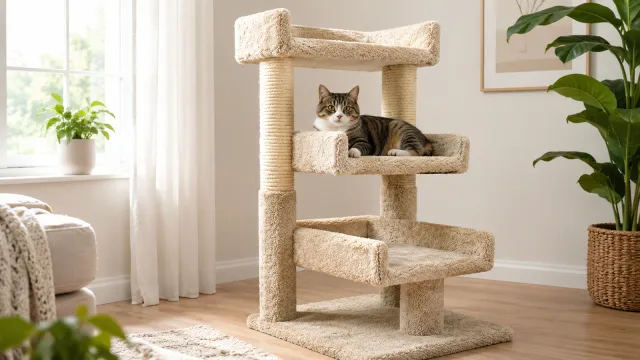
- The cats’ room. Shelving, perches, hiding places, litter stations with their own extraction, and a separate quarantine or isolation space.
- Insurance and legal fees. Expect to pay for a policy that covers both scratches and spilled coffee, plus the lawyer’s or consultant’s time to get through the permits.
Monthly Costs and How Cafes Earn Money
Rent is usually the biggest monthly cost, followed by staff and then the cats. Before its downtown branch closed in May 2025, Toronto’s Lazy Cat Café said it paid about C$12,000 a month in rent, around C$3,500 for utilities and roughly C$10,000 more for vet care, food, litter and staff, according to NOW Toronto. In 2025, the manager of Second Cup Cat Café in Olathe, Kansas, told FOX4 that its costs ran to $14,000 to $15,000 a month, while its best month that summer brought in about $13,000. The owner paid the difference herself until the location closed after 800 adoptions.
Charge for entry. Admission is the backbone of the business. Of the 686 cafes in our directory whose websites explain how visits are charged, 92% charge an entry or time-based fee. Only 6% just ask you to buy food or a drink, and 2% are free. The cafes that started without a fee tend to regret it. Besides San Diego, Denver Cat Company opened without one in 2014. Its founder said she made no money in the first year, and by the first anniversary it charged $3 on weekdays and $5 at weekends.
Typical US prices in 2026 run from $10 to $25 for 30 to 60 minutes. Cat Town charges $14, Mew Haven $16, and Meow Parlour in New York $23 plus tax for 50 minutes. Espurresso in Lawrence, Kansas, charges $10 for half an hour or $15 for an hour.
The other income streams are smaller, but they add up:
- Memberships reward regulars. Katy’s Cat Cafe in Sarasota charges $20 for a day with no time limit, or $128 a month for a membership.
- Events fill quiet hours at a higher price. Le Cat Café in Philadelphia runs yoga classes of 45 minutes followed by half an hour with the cats. Birthday parties, paint nights, quiz nights and book clubs are common too.
- Food and drink usually bring in less than you’d expect, because the health rules limit what you can serve near the cats. Wang says sales other than admissions, including food, drink and merchandise, make up about a quarter of The Cat Cafe’s revenue.
Adoption fees usually go to the rescue partner. Orlando Cat Café and Catelowna in Kelowna both pass on 100%. If you run the rescue yourself, check the arithmetic. In 2024 The Bad Cat Café in Wallsend, England, charged £130 to adopt a cat, but neutering and microchipping alone cost it £140 for a male and £170 for a female.
Is a Cat Cafe Profitable?
Some are, and many only just break even. The Cat Cafe in San Diego told Starter Story in 2024 that it brings in $40,000 to $50,000 a month, depending on the season, and is profitable despite rising labor costs. The founder of Orlando Cat Café has said her only goal in 2016 was to break even. Ten years later the cafe has welcomed more than 230,000 visitors and placed more than 3,500 cats, and it now sells franchises.
At the small end, margins are thin. Cattyshack, a nonprofit cat lounge in Huntsville, Alabama, reported $80,291 in revenue and $82,511 in expenses for 2023. Even Cat Town spent more than it raised in 2023.
We have marked 88 of the cat cafes in our directory as permanently closed, 33 of them in the US. When an owner gives a reason, it is usually one of these:
- Rent. In 2025 The Cat Cafe in Singapore announced that it would close its Rail Mall branch in March 2026 after a 50% rent increase. Buckminster’s Cat Cafe in Buffalo closed in 2025 when its lease ran out, after about 1,000 adoptions.
- Debt and rising costs. Lady Dinah’s, the UK’s first cat cafe, closed in June 2025 under pandemic-era debts and rising costs. Its manager crowdfunded to buy the assets without the debt, and it reopened in Greenwich in 2026.
- People. Louisville’s nonprofit Lucky Cat Café closed in April 2025, citing rising costs and the loss of key staff and volunteers.
- Vet bills. In January 2023, Catoro in Vancouver nearly closed under pandemic debt and vet bills, and was saved by a GoFundMe that raised more than C$100,000.
Permits and Licenses in the US
There is no national cat cafe license. You will deal with at least two regulators, one for the food and one for the animals, and often a zoning office as well.
The Food Side
Most states base their food rules on the FDA’s model Food Code, which bans live animals from food businesses. The few exceptions cover things like aquariums, service animals and caged pets in areas not used for food or dining, such as pet shops. None of them covers cats roaming a cafe. The 2026 Food Code, released in September, left that chapter unchanged. States and cities adopt the code on their own schedule and amend it, so the details depend on your local health department. In practice, US cat cafes do one or more of the following:
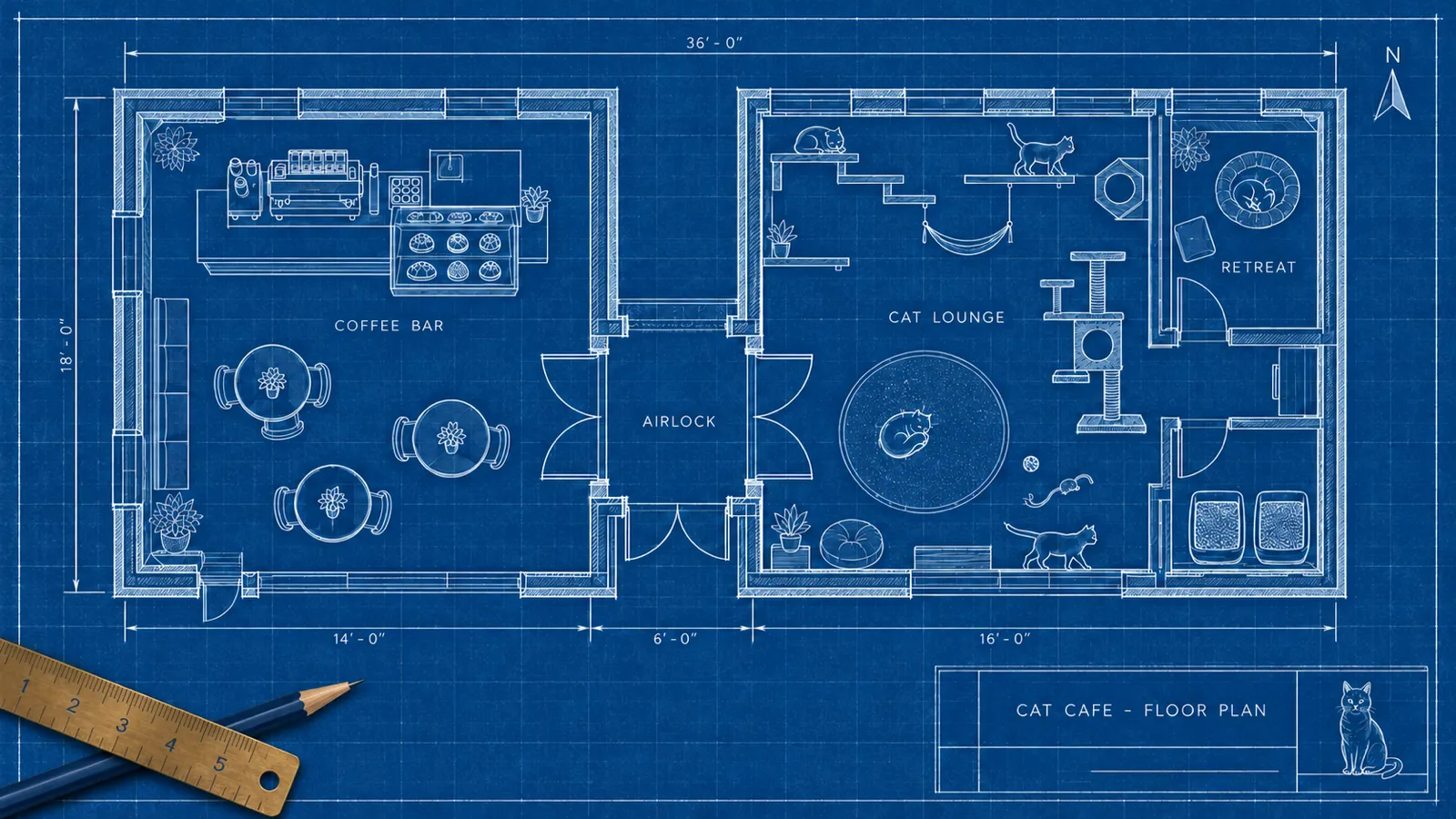
- Build two separate spaces. Cat Town’s cafe and cat room are joined by a corridor with a door at each end. Air flows only from the cafe toward the cats, and staff and restrooms are kept apart, as TIME reported when it opened.
- Serve food through a hatch. At KitTea in San Francisco, tea and snacks pass into the walled-off cat room through a slot in the wall, and the founder said the health department required a medical-grade HEPA air filter.
- Keep food off site. In New York, Meow Parlour opened as two businesses across the street from each other, and guests carried their pastries over from the patisserie. Crumbs & Whiskers dropped on-site food and partnered with a bakery across the street.
- Keep the menu simple. Of the cafes in our directory that describe their food, 72% serve only drinks and snacks, often prepackaged or made off site, 25% serve full meals and 3% serve nothing.
Small slips count. In September 2015, DC Health briefly closed Crumbs & Whiskers because guests were pouring themselves free coffee inside the cat room. Since the cafe charged admission, inspectors treated the coffee as a food sale it wasn’t licensed for. It reopened within hours with separately priced drinks.
The Animal Side
The cats usually need a license of their own, and many first-time owners don’t expect it. Seattle and King County permit cat cafes under both a pet business and a food business program. Staff may work only one side per shift, litter may never be carried through the food area, and each side is inspected separately. In Colorado, any place that keeps pets for adoption needs a state Pet Animal Care and Facilities Act license. Since December 2025, shelters and rescues in New York, including those linked to cafes, have needed a state license and are subject to unannounced inspections.
The wrong license can be as bad as none. In Rhode Island, officials removed every cat from Bajah’s Cat Cafe after a complaint. The RISPCA found the cats healthy, but the owner was fined because her license covered a pet shelter rather than a rescue, the Community Sentinel reported in 2026. In 2018, San Antonio’s Animal Care Services temporarily closed the city’s first cat cafe, where about 50 cats in a single room had respiratory infections. It could only reopen with an animal facility permit and surprise inspections.
Zoning, Insurance and Landlords
Check zoning before you sign anything. Washington, DC’s zoning board had no category for a cat cafe and approved Crumbs & Whiskers as an “animal boarding use for cats”, capped at 20 cats. Chicago wrote a new Animal Shelter Cafe permit in 2016 that only licensed humane societies can hold. Tree House, run by Tree House Humane Society, has its cat cafe inside its shelter (see our Chicago guide).
Insurance shapes the rules your guests follow. A Sanctuary Cafe in Boston says the insurer that wrote Massachusetts’ first cat cafe liability policy barred children under eight, and it follows the same rule. The founders of Seattle Meowtropolitan spent more than 18 months on permits and needed a custom policy that covered both cat scratches and coffee burns. Bites do lead to claims: Denver Cat Company was sued over one in 2015. Many US cafes, including A Sanctuary Cafe and Crumbs & Whiskers, have every guest sign a waiver.
Finding a landlord may be the hardest step. The owner of The Cat’s Meow Cafe in Bloomington, Illinois, told WGLT that finding someone willing to lease to a mix of food and animal care was the hardest part of opening. The founders of Kitty Cat Cafe and Adoption Lounge pitched about 20 Massachusetts towns before a health director in Peabody said yes.
Rules Outside the US
The same principle applies almost everywhere: no cats where food is prepared. Beyond that, each country regulates the animal side differently.
- United Kingdom. Register with your council as a food business at least 28 days before you open. There is no cat cafe licence. Councils that do license cafes usually use the animal exhibition licence under the 2018 regulations, as Lady Dinah’s does, and the RSPCA says the law is unclear on whether a licence is required at all. In March 2025 the RSPCA and Cats Protection called for cat cafes to be phased out and urged councils to stop issuing licences. In a 2025 consultation in Wales, most respondents favoured a ban, but no decision has been made. Expect licensing to get stricter.
- Japan. A cat cafe must register with its prefecture as an animal handling business in the display category, renew every five years and employ a qualified, full-time animal handling manager. Cats aged one or older may be on show until 10 p.m., with no more than 12 hours of display a day and constant access to a rest area. Since 2021, national standards have also capped staffing at 30 cats per full-time keeper. You also need a restaurant permit to serve food.
- Germany. You need a permit from the local veterinary office under section 11 of the Animal Welfare Act before you open. You must prove you know how to keep cats and that you are reliable, and pass a premises inspection. Founders report conditions such as an entrance airlock, a counter the cats can’t reach and a retreat room.
- Canada. Ontario’s food rules keep animals out of every room where food is prepared or served, so cafes there and in British Columbia keep the cats in a separate room. In Quebec, a business that keeps 15 or more cats or dogs needs a provincial permit.
- Australia. The national food standard bans live animals wherever food is handled, so cafes separate the two areas. Cat Café Melbourne needed airlocks between the food and cat areas and about three months of council approval. In the ACT, keeping four or more cats requires a multiple cat licence.
Designing the Space Around the Cats
The cat room is a home before it is an attraction. Shelters’ guidance for group cat rooms is a good starting point. The ASPCA’s communal cat room guidelines recommend:
- Group size: no more than 10 to 12 cats in a room, however big it is.
- Floor space: at least 18 square feet per cat.
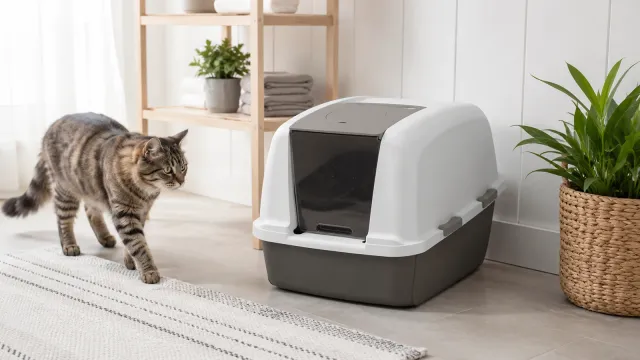
- Litter: at least one box for every two cats, ideally one each, kept 3 feet or more from food.
- Perches and hiding places: more perches than cats, and somewhere for every cat to hide.
A 2025 study of a Stockholm cat cafe showed what happens when the room fills up. On busy days, the cats moved higher up and played and groomed less. The cafe gave its cats an 18-square-meter room that only staff could enter, and had two or three staff on each shift. The authors recommend lots of vertical space, hiding places, a private cats-only area, a cap on visitor numbers and contact only when the cats choose it.
Health checks need to be a written routine. Kitty Cat Cafe in Peabody publishes its protocol:
- Litter is cleaned three times a day, in a cats-only room whose air is vented outside.
- Every cat is checked daily from eyes to coat, and weighed and screened for ringworm weekly.
- New and sick cats go into a quarantine room with its own air supply.
Most partner rescues spay or neuter, vaccinate, microchip and test for FIV and FeLV before a cat arrives. Ringworm is a real risk in a shared room. A 2024 study of 11 Bangkok cat cafes found it on 16% of the cats, and it can spread to people. Don’t overfill the room. After the San Antonio cafe was closed with 54 cats in about 1,000 square feet, the city said it wanted 10 to 20 cats there.
Not every cat is suited to cafe life. Lady Dinah’s founder said in a 2016 interview that fearful cats were rehomed rather than placed in the cafe. New cats were introduced gradually, first by swapping scents with the residents and then through short supervised meetings.
Be ready to defend your welfare standards, because critics will ask. The RSPCA and Cats Protection argue that cafes force cats into close contact with strange cats and people, that stress is easy to miss in a cat that pretends to sleep, and that cats in some shopping-center cafes never see daylight. Cat-only retreats, caps on visitors and handling, care over which cats live in the cafe, and openness about where they come from are the best answers to that criticism.
Running the Cafe Day to Day
Expect your staff to do everything from making lattes to scooping litter. The Cat’s Meow Cafe in Bloomington runs on nine staff and 16 to 18 cats from its rescue partner. It opens from 7 to 11 a.m. and 3 to 7 p.m., closes in the middle of the day so the cats can rest, and allows no more than 20 people in the cat room. It placed more than 140 cats in its first seven months. Orlando Cat Café’s franchise model calls for a team of about eight part-timers.
Staffing is also where disputes start. Crumbs & Whiskers in Washington closed for about six weeks in early 2026 amid a dispute with staff who were forming a union. It reopened in March as what its owner calls the first unionized cat cafe in the US.
Here is how the cafes in our directory handle visits:
- Booking: 61% recommend a reservation, 17% require one and 21% welcome walk-ins.
- Children: half welcome all ages, and half set a minimum age.
- House rules: guests wash their hands on arrival, don’t pick up the cats, leave sleeping cats alone and turn off the camera flash. Lady Dinah’s also allows only one person to interact with a cat at a time, and Meow Parlour has separate hours for young children.
Burnout is common. The owners of the Manx Cat Café on the Isle of Man ran it seven days a week for more than five years while both worked full-time jobs, and are closing it at the end of October 2026. Adoptions take an emotional toll too. Owners and staff get attached to every cat, and saying goodbye to them is part of the job. Plan for days off, a deputy who can open without you, and a vet who understands what you do. The owner of Coffee Cats in Lincoln, England, has said finding a vet who accepted the business was difficult at first.
Before You Sign a Lease
- Call the local health department with a floor plan and ask what separation it needs between food and cats, and whether it will allow any food at all.
- Ask which animal license applies: pet business, shelter, rescue, kennel or boarding. If you plan to rescue cats as well, ask whether you need a second license for that.
- Check zoning for an animal use at the address, along with any limits on how many cats you can keep.
- Find a rescue partner and agree in writing who pays which vet bills, who screens adopters, how many cats rotate in and what happens if the cafe closes.
- Get insurance quotes for both food and animal liability before you commit. The insurer may set your minimum age.
- Budget for the build-out: walls, double doors, ventilation, a quarantine room, cat furniture and litter extraction.
- Set your admission price from your rent and payroll, not from what you think people will pay for coffee.
- Visit cat cafes and talk to their owners. Most are happy to share what they wish they had known. You can find the ones near you on our map.
Frequently Asked Questions
How much does it cost to open a cat cafe?
There’s no standard figure. Reported costs run from about $10,000 for a small lounge without a kitchen in Missouri in 2026 to more than $400,000 for an Orlando Cat Café franchise. Rent, construction to separate the cats from the food, and what your landlord asks for up front drive most of the difference.
Do cat cafes make money?
Some do. The Cat Cafe in San Diego reports that it is profitable, and Orlando Cat Café has grown into a franchise. Many others only break even or rely on donations, and 33 US cat cafes in our directory have closed. Charging admission from the start matters more than anything else.
Do you need a license to open a cat cafe?
Almost always, and usually more than one. In the US that means a food permit if you serve anything, often an animal facility, shelter or rescue license, a business license and a zoning approval. The requirements depend on your state and city, so start with your local health department.
Can cats be in the same room as the food?
In the US, UK, Canada, Germany and Australia, cats can’t go where food is prepared or stored. Most US health departments also want the cats kept out of the room where food is served, so cafes use a separate cat lounge, sell food through a hatch, or serve only prepackaged snacks.
Already Running a Cat Cafe?
If your cafe isn’t on Cat Cafe Map yet, get in touch and we’ll add it for free. Owners can also send updated prices, hours and adoption numbers so visitors find the latest details. For more figures on how cat cafes work around the world, see our cat cafe statistics.