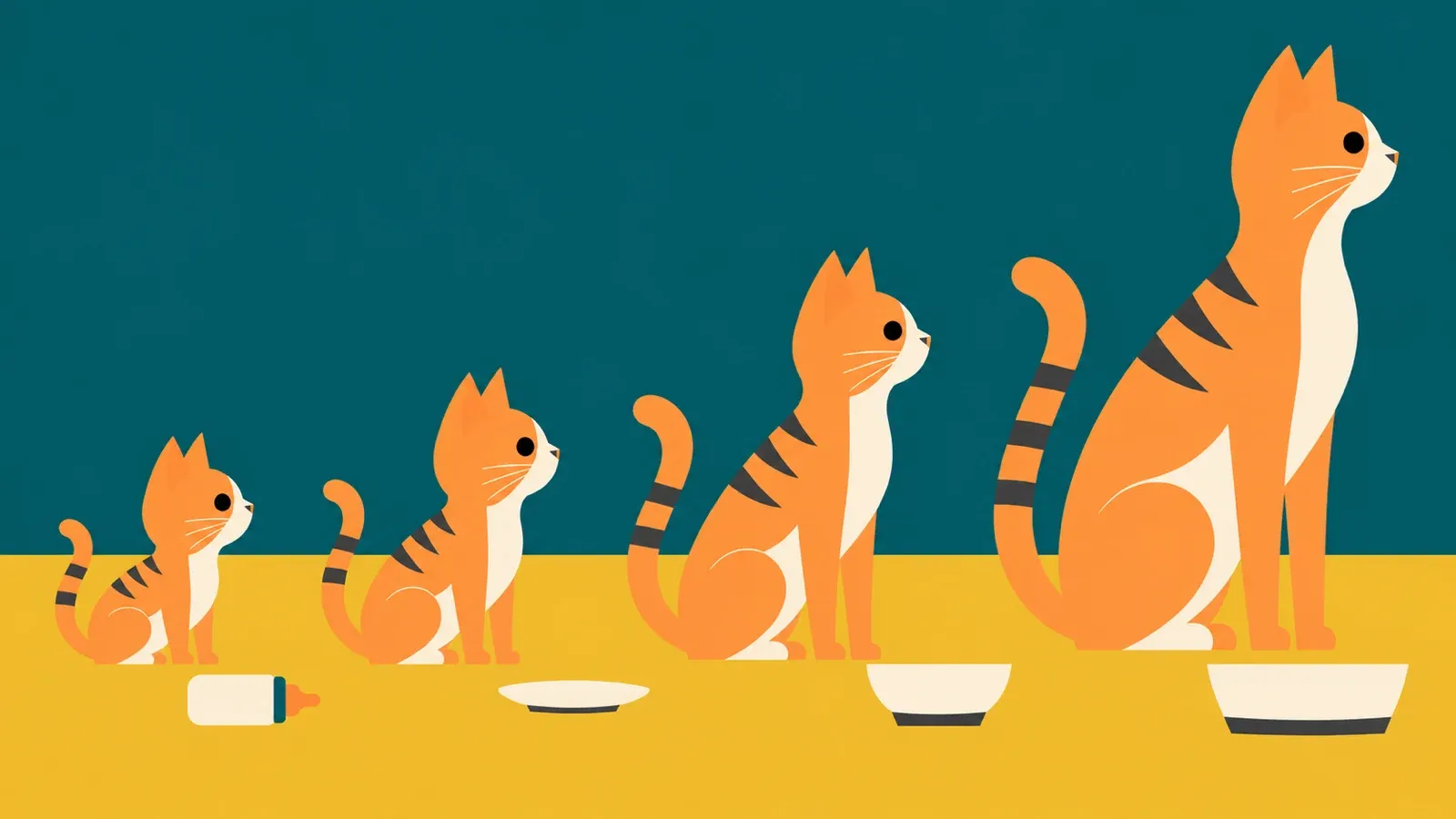
A kitten changes from a milk drinker to a meat eater in about eight weeks, and goes on growing fast for months after that. What it needs changes almost week by week, so here’s what to feed at each age, how often and how much. Sources don’t always agree, so where they differ we say so.
Here’s the short version:
- Under 4 weeks: kitten formula or its mother’s milk only, never cow’s milk.
- 3 to 8 weeks: weaning. Move gradually from formula to wet kitten food, then add dry.
- 2 to 6 months: kitten food in three or four small meals a day.
- 6 to 12 months: kitten food in two or three meals a day.
- About 12 months: switch to adult food over a week or more. Large breeds may need longer on kitten food.
Kitten Feeding Chart
| Age | What to feed | How often |
|---|---|---|
| 0–1 week | Mother’s milk or kitten formula | Every 2 hours |
| 1–2 weeks | Mother’s milk or kitten formula | Every 2–3 hours |
| 2–3 weeks | Mother’s milk or kitten formula | Every 3 hours |
| 3–4 weeks | Milk or formula, with a first taste of wet kitten food | Every 4 hours |
| 4–5 weeks | Formula mixed with wet kitten food; weaning under way | Every 5–6 hours |
| 5–6 weeks | Wet kitten food, with soaked kibble if you like, and water | Every 6–8 hours |
| 6–8 weeks | Wet kitten food and dry kitten food, and water; weaning finishes | Every 8 hours, or more often |
| 2–4 months | Kitten food | 3–4 small meals a day |
| 4–6 months | Kitten food | 3 meals a day |
| 6–12 months | Kitten food; watch weight after neutering | 2–3 meals a day |
| About 12 months | Move to adult food | 2 or more meals a day |
The milk schedule follows Kitten Lady’s fostering guide. Other guides allow longer gaps: VCA Animal Hospitals says every 2–4 hours in the first week and every 4–6 hours after that, and the ASPCA’s foster guide says every 3–4 hours under two weeks. The meals in the lower rows are our summary of VCA and the Merck Veterinary Manual, which say three or four meals a day in the early months, reducing as a kitten grows. A kitten that’s nursing from a healthy mother feeds when it likes, so you only need the milk rows for orphans.
Bottle Feeding: Birth to 4 Weeks
Use a formula made for kittens. VCA explains that a mother cat’s milk has more than twice the protein of cow’s milk, and that cow’s milk has less fat, calories and taurine, and more lactose. Kitten Lady also rules out dairy alternatives and human baby formula. PDSA warns that supermarket kitten milk isn’t suitable either, since treat “cat milk” isn’t a formula.
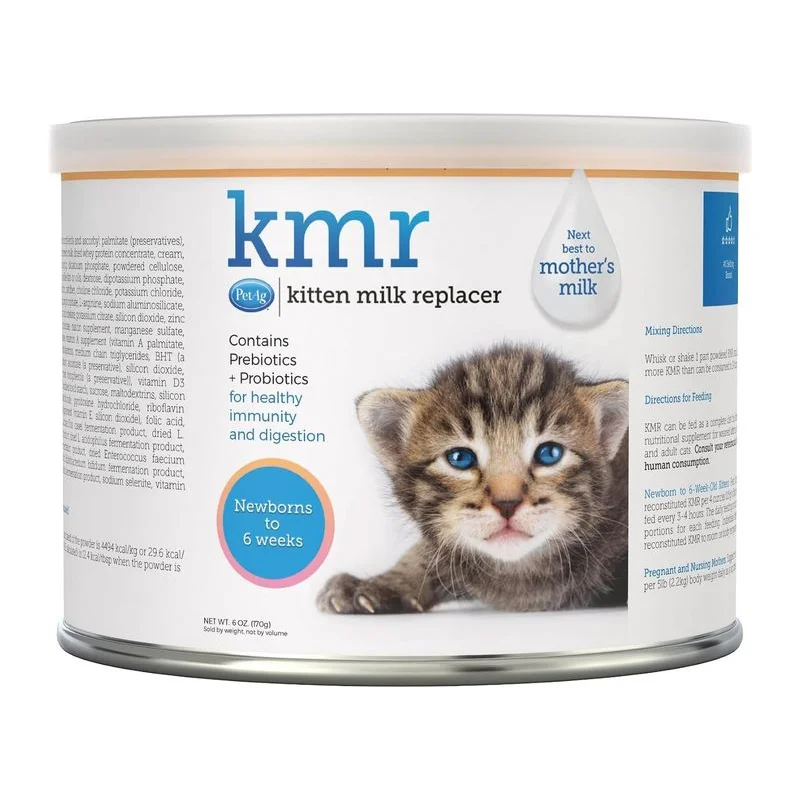
Kitten Formula
PetAg KMR Kitten Milk Replacer Powder
A long-established powdered kitten formula. You mix 1 part powder with 2 parts warm water, and make no more than a kitten will drink in 24 hours. More than 8,000 ratings on Amazon, averaging 4.8 stars.
Buy on AmazonFollow the instructions on the formula you buy. As a guide, here’s Best Friends Animal Society’s chart, which goes by weight, since orphans vary a lot:
| About | Weight | Formula per day | Feeds per day |
|---|---|---|---|
| Newborn | 100 g (3.5 oz) | 27 mL | 7 |
| 1 week | 150 g (5.3 oz) | 40 mL | 7 |
| 2 weeks | 250 g (8.8 oz) | 68 mL | 7 |
| 3 weeks | 350 g (12.3 oz) | 95 mL | 6–7 |
| 4 weeks | 450 g (15.9 oz) | 122 mL | About 5 |
| 5 weeks | 550 g (19.4 oz) | 148 mL | About 4 |
The chart warns against feeding larger amounts less often, because a kitten’s stomach holds only about 4 mL per 100 g of body weight, and overfilling it risks regurgitation, breathing formula into the lungs and diarrhea. For the same reason, warm a cold kitten before feeding, as VCA and Merck advise, because a chilled kitten can’t digest properly.
Weigh your kitten every day. A gram scale is the simplest way to catch a problem early. Kitten Lady suggests weighing at every feeding, or at least daily, until weaning. Expect gains of about 7 to 14 g a day. VCA gives at least 7 g a day, or about 100 g a week. Cats Protection says 10 to 15 g a day. A kitten that stops gaining or loses weight needs a vet quickly. Orphans under four weeks are fragile, so ask your vet or a local rescue for help as well.
Weaning: 3 to 8 Weeks
International Cat Care says weaning can start at about 3 to 4 weeks and is usually finished by about 8 weeks. Others vary a little: Kitten Lady suggests waiting until about 5 weeks, once the back teeth are coming in. If a kitten is nursing from a healthy mother, she handles most of this herself. If not, go slowly:
- Start with a slurry. Mix formula with a little wet kitten food. Cats Protection suggests a shallow bowl, and adding more food over time.
- Keep offering formula. Give a bottle after meals while your kitten learns to eat, so that it doesn’t go hungry.
- Add water. Put out a shallow dish from about 3 to 4 weeks, once kittens begin weaning.
- Add soaked kibble. See the next section.
- Thin the formula out. As the kitten eats more solid food, stop the bottles, watching its weight all the time.
Kittens walk in their food and get filthy at this stage. That’s normal. Wipe them with a warm, damp cloth, and dry them so they don’t get cold.
When Can Kittens Eat Dry Food?
Kittens can start on softened dry food at about 4 weeks, and most can eat it dry by about 6 weeks. There’s no single rule, and we found no study comparing ages:
- International Cat Care suggests wet food, or kibble soaked in water until it’s thoroughly moist, at the start of weaning.
- The ASPCA’s foster guide says kittens at four weeks may be ready to try dry food, and by six weeks should be eating dry kitten food with some canned food on the side.
- Kitten Lady prefers wet food as a start, but also suggests introducing kibble during weaning, so that kittens accept both.
Soak the kibble in warm water or formula at first, then use less water over a week or two. Make sure the kibble is made for kittens, because the pieces are smaller and the nutrients match growth.
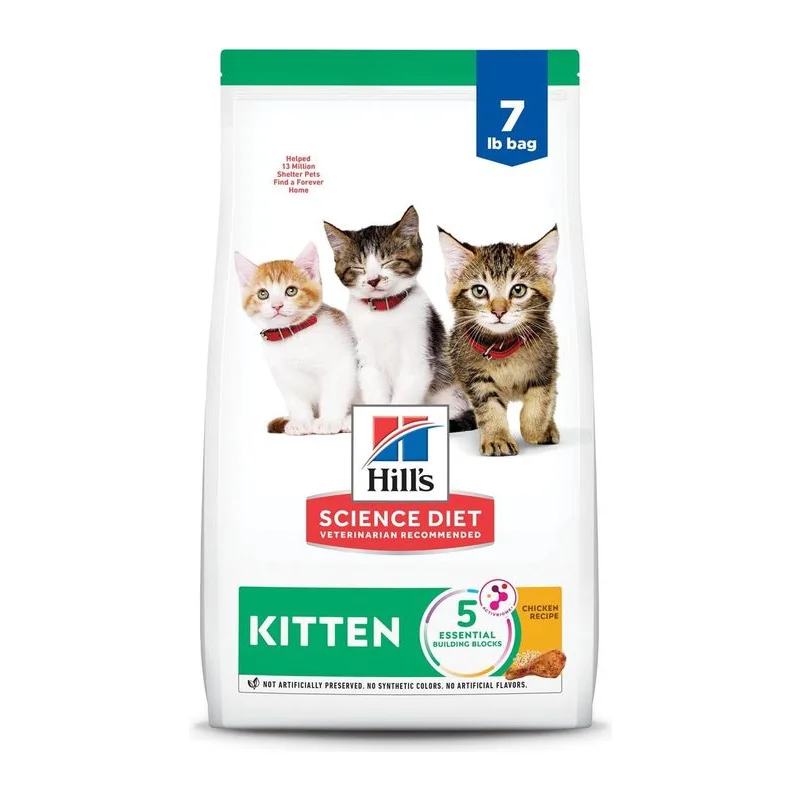
A Widely Available Dry Kitten Food
Hill's Science Diet Kitten Dry Food
A chicken-based dry food for kittens with DHA from fish oil. It's widely sold, with more than 11,000 ratings on Amazon averaging 4.8 stars.
Buy on AmazonHow Much Should I Feed My Kitten?
Start with the label. Every food has a different calorie density, so no chart can tell you how many grams to give. In the US, labels must show calories per kilogram and per can or cup, and feeding directions by weight. Treat those directions as a starting point, then adjust to your kitten’s weight and shape.
To work it out yourself, the Merck Veterinary Manual gives a resting calorie formula, 70 × (weight in kg)^0.75, and multiplies it by 2.5 for kittens. We’ve used that to make this table:
| Kitten’s weight | Calories per day | Dry food at 3,570 kcal/kg | Wet food at 90 kcal per can |
|---|---|---|---|
| 0.5 kg (1.1 lb) | About 105 | About 29 g | About 1.2 cans |
| 1 kg (2.2 lb) | About 175 | About 49 g | About 2 cans |
| 1.5 kg (3.3 lb) | About 235 | About 66 g | About 2.6 cans |
| 2 kg (4.4 lb) | About 295 | About 82 g | About 3.3 cans |
| 3 kg (6.6 lb) | About 400 | About 112 g | About 4.4 cans |
The food columns are only examples, so use your own food’s numbers. The dry figure comes from a sample food in Tufts University’s guide, and the 90 kcal per 3 oz can is an illustration we chose. Divide the daily calories by the calories per gram or per can on your label.
Merck says individuals can vary by up to 30%, and it gives one multiplier for all kittens, so these figures are likely to be too high for older kittens, particularly neutered ones. Use the lower end as your kitten nears adult size. For comparison, the World Small Animal Veterinary Association puts a healthy 3 kg adult at only about 200 to 210 calories a day.
Weigh the food and the kitten. Tufts nutritionists prefer a scale to a measuring cup, and a 2024 review of feline obesity calls a gram scale the most accurate way to measure food. The same review suggests weighing older kittens every week or two. You should be able to feel your kitten’s ribs under a thin layer of fat, and see a waist from above. Ask your vet if you’re unsure.
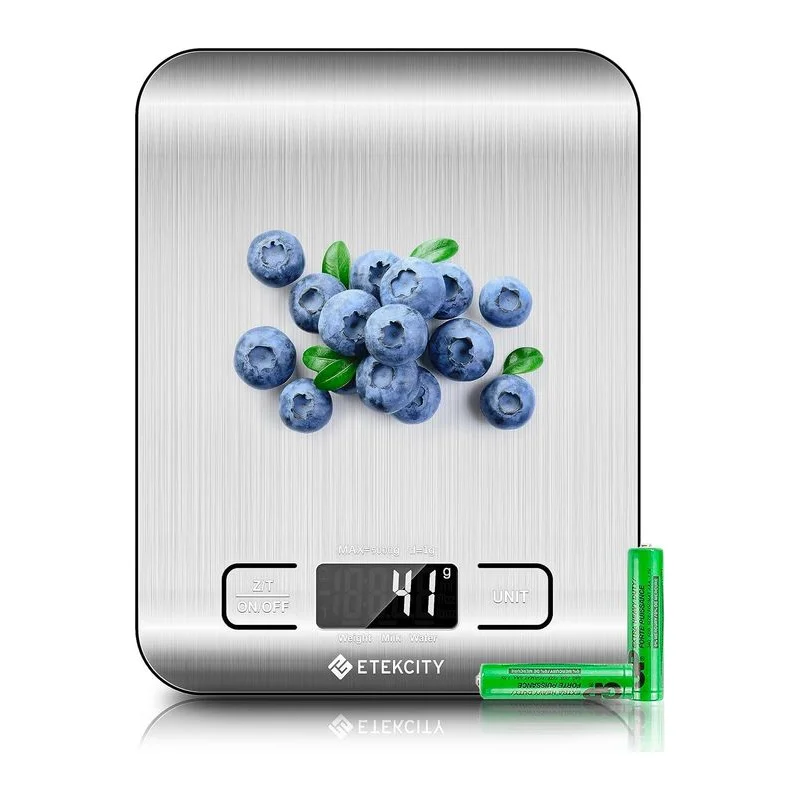
For Weighing Food and Small Kittens
Etekcity Food Kitchen Scale
A cheap digital kitchen scale that reads in 1 g steps up to 5 kg (11 lb), with a tare button. It's Amazon's long-time favorite, with more than 170,000 ratings.
Buy on AmazonHow about free feeding? Sources differ. Merck’s professional guide lists feeding freely as an option, and the ASPCA allows it with dry food, but VCA warns that free-choice feeding raises the risk of a kitten becoming overweight, and that portions are easier to adjust. We’d use measured portions once your kitten is past weaning. If you like, leave part of the day’s dry food out and give the rest as wet meals.
How Much Wet Food to Feed a Kitten
No vet source we found gives a set amount of wet food by age, because cans differ too much. Use the calorie sums above, and split the day’s cans across meals. If you also feed dry food, count both. For example, a 2 kg kitten needing about 295 calories could have two 90-calorie cans (180 calories) and about 32 g of the dry food above (115 calories). Treats should stay within about 10% of the day’s calories, though sources range from 5% to 15%.
Wet and dry are both fine as long as the food is complete and balanced for growth. Each has advantages:
- Wet food has more water. Cornell puts canned food at 75% moisture or more, against 6% to 10% for dry. In a small study of adult cats, those fed the driest version of a diet took in about 30% less water, though it was a study of six cats and doesn’t show that wet food prevents disease.
- Dry food is cheaper and keeps longer. See our guide on what a cat costs.
- Neither prevents weight gain by itself. In a UK study of 375 cats, mostly dry diets at age 2 were linked to being overweight, and so was feeding a lot of wet food to young kittens. Portions matter more.
- Offering both keeps options open. International Cat Care says offering both can help kittens accept different textures later, which is useful if your cat one day needs a special diet.
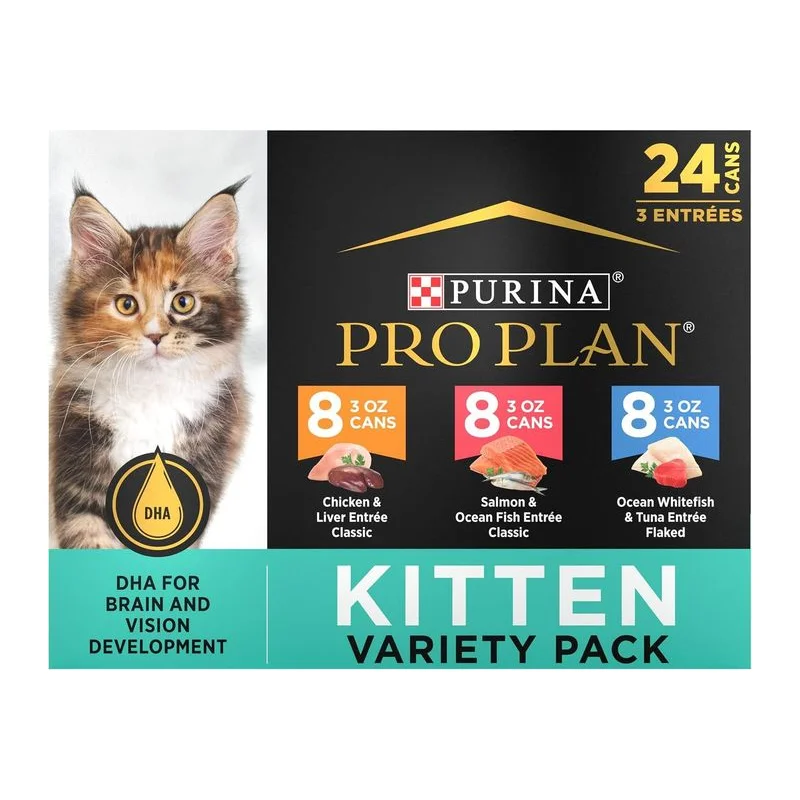
A Wet Kitten Food Variety Pack
Purina Pro Plan Development Kitten Wet Food
A pack of 24 3 oz cans in chicken and liver, salmon and ocean fish, and whitefish and tuna, with DHA. More than 5,800 ratings on Amazon, averaging 4.7 stars.
Buy on Amazon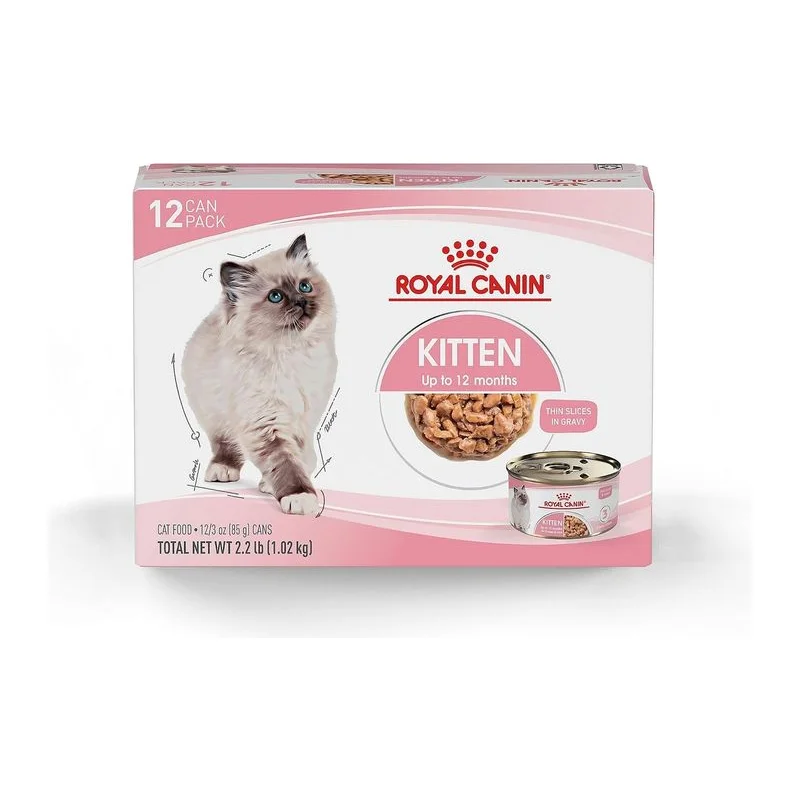
For Fussier Kittens
Royal Canin Kitten Thin Slices in Gravy
Thin slices in gravy, made for kittens up to 12 months old, in a pack of 12 3 oz cans. A useful change of texture if your kitten isn't keen on pâté. More than 5,500 ratings on Amazon, averaging 4.7 stars.
Buy on AmazonWe didn’t test these on kittens, and we found no independent evidence that favors one kitten food brand over another. Picks like these are large makers’ foods that are easy to find. Whatever you buy, look for a statement on the label that it’s complete and balanced for growth or for all life stages, and see the questions below.
How Long Should Kittens Eat Kitten Food?
About a year, for most kittens. Tufts says you can switch after one year, and VCA says at one year or at maturity, whichever is later. VCA notes that most cats mature between 9 and 12 months, but large breeds such as Maine Coons can take up to 18 months. Merck’s owner guide says about 9 to 12 months. There’s no need to rush: Tufts says there’s no hurry if your kitten is at a healthy weight.
Watch for weight gain after neutering. This is when many cats start to get fat. The 2024 review reports that energy needs can fall by up to 30% after neutering, while appetite can rise by up to 50%. Kittens still need growth food, so don’t put yours on a diet: reduce the portion and keep weighing. UK charity PDSA goes further, and suggests that a kitten neutered at 4 months moves to neutered-cat food at about 6 months, which is earlier than most other sources. Ask your vet which suits your kitten.
Switch gradually. Tufts recommends mixing in more of the new food over at least a week, and some pets need four to six weeks. Offering the new food in a separate dish can help a fussy cat.
Can Adult Cats Eat Kitten Food?
They can, but it isn’t ideal in the long term. VCA says kitten food may be too rich for adults and lead to excess weight gain. It’s fine if an adult cat steals a few bites. If you have a kitten and an adult, feed them separately, for example with a microchip feeder or by putting the kitten’s food where the adult can’t reach it. Pregnant and nursing cats need far more energy than usual, up to two or three times normal during nursing, according to Merck, so ask your vet what to give them. Foods labeled for all life stages are made to cover reproduction as well as growth.
Can kittens eat adult food? A bite won’t hurt. As a regular diet, it’s a poor choice, because adult food typically lacks the extra nutrients a growing kitten needs.
What Not to Feed a Kitten
- Cow’s milk. It can cause an upset stomach and diarrhea, as the ASPCA notes. Water is all a weaned kitten needs to drink.
- Raw meat diets. The World Small Animal Veterinary Association recommends against them, and in testing by the FDA, 15 of 196 raw pet food samples had Salmonella and 32 had Listeria.
- Toxic foods. The ASPCA lists onions, garlic and chives, to which cats are especially sensitive, plus chocolate, caffeine, alcohol, xylitol and yeast dough.
- Bones. They can cause blockages and broken teeth.
- Dog food. It doesn’t meet a cat’s needs, including for taurine.
- Vegetarian diets. Cats need nutrients found in animal foods, and vets generally advise against them.
- Supplements, unless your vet recommends them. VCA says a proper kitten food has everything your kitten needs.
- Too much canned tuna made for people. Cornell advises against it.
Grain-free isn’t something to pay extra for. Tufts calls it mostly marketing, and notes that grain allergies are rare.
Keep fresh water available from the start of weaning, replaced every day. A cat water fountain can come later if your kitten likes running water.
How to Choose a Kitten Food
Marketing words don’t tell you much. The World Small Animal Veterinary Association suggests these checks:
- Read the adequacy statement. It should say the food is complete and balanced for growth or all life stages, and whether that’s by formulation or by feeding trials.
- Find the calories. You need them to work out portions.
- Ask who makes it. A good maker should tell you whether it employs a qualified nutritionist, who formulates its diets, what quality control it does and what research it has published.
Tufts’ nutritionists warn that pet food rating sites often rest on marketing or myths, and that words like “premium” and “holistic” aren’t regulated.
When to Call the Vet
Kittens can go downhill fast, so don’t wait and see. Get help straight away if your kitten:
- Is weak, lethargic, cold or unresponsive, or is having twitches or seizures, which can be signs of low blood sugar.
- Refuses food. The ASPCA tells fosters to call after two missed feedings in a row for bottle babies. We found no agreed time limit for weaned kittens, so call the same day.
- Stops gaining weight or loses weight.
- Has diarrhea, especially if it’s also vomiting, not eating or quiet, or if there’s blood in it. In a bottle-fed kitten, diarrhea can also be a sign of overfeeding or formula mixed too strong, but ask your vet.
- Has formula coming from its nose, or crackly breathing after a feed, which can mean it has breathed in formula.
Feeding a Kitten in Short
Formula or its mother’s milk until about 4 weeks. Weaning on wet food and soaked kibble until about 8 weeks. Then three or four small meals of kitten food a day, dropping to two or three by 6 months, and adult food at about a year, or later for large breeds. Weigh your kitten and its food, follow the calories on the label, and cut portions back after neutering if your kitten starts to look round. For the rest of a new kitten’s care, see how to litter train a kitten and our checklist of everything you need before adopting a cat.