A cat on a harness can sniff the grass and sit in the sun without meeting a car. But many cats hate the whole idea, and a badly fitted harness can let a frightened cat slip free somewhere it doesn’t know. The harness you buy matters less than the fit and the weeks of slow training before you open the door.
We compared cat harnesses on how securely they fit, how easily they go on, how many sizes they come in, and what owners and hands-on reviewers report. We didn’t run our own escape tests. These are the ones we recommend.
- Best overall: the rabbitgoo Cat Harness and Leash Set, a soft mesh vest that adjusts at the neck and chest, with a leash included.
- Best if your cat hates things over its head: the Voyager Step-In Air, which your cat steps into and you fasten on its back.
- Best for wrigglers: the Kitty Holster, a cotton vest with wide hook-and-loop closures and no buckles.
- Best strap harness: the PetSafe Come With Me Kitty, a light harness with a stretchy bungee leash.
Should You Walk Your Cat at All?
Cat welfare groups disagree, and it’s worth knowing that before you buy anything.
UK charities are against it. Cats Protection says plainly that walking a cat on a harness and lead is not recommended, because most cats dislike being restrained, want the choice to run from danger, and feel safest on their own territory. PDSA says most cats will feel seriously stressed by it, and that a cat can hurt itself trying to escape.
Vets and shelters in North America and New Zealand are more open to it. The Feline Veterinary Medical Association lists walking on a harness and leash as a way to give cats a more stimulating environment while reducing the risks of going outside, alongside enclosures and cat-safe fences. SPCA New Zealand supports it if the equipment is well fitted and secure, and the walk stops when the cat shows stress.
There’s very little research either way. The one peer-reviewed study we found on cat walking interviewed 21 owners who already walk their cats. They reported benefits for the cat and themselves, and named dogs and their owners as a main problem. That tells you what committed owners believe, not how their cats feel.
Our view: a harness suits a confident, curious cat, and it isn’t a duty. Best Friends’ cat behaviour expert estimates that only a small percentage of indoor cats are relaxed enough by nature to feel safe outdoors, and none of the expert’s own three cats wants to go out on a harness. San Francisco SPCA is more optimistic about training, but also says that walks aren’t a good way to enrich a fearful cat. If your cat hides from visitors or panics at noises, leave the harness in the box and try a window perch or a catio.
A harness can still be useful for a cat that never goes for a walk. It gives you something to hold during travel, for example, and San Francisco SPCA suggests it for safely introducing two cats. If you’re getting a harness for travel, read our guide to the best cat carriers too, since a harness doesn’t replace a carrier.
No Harness Is Truly Escape-Proof
Almost every harness on Amazon says “escape proof” in its title. Ignore that. SPCA New Zealand says outright that no harness is escape-proof, and Fear Free warns that a cat frightened by a sudden noise could bolt right out of even a snug one. Kitty Holster’s own listing says there’s “no true escape proof cat harness”. Best Friends’ expert describes seeing many lost-cat posts with the same story: a loud noise, a panic, a slipped harness.
A good fit lowers the risk, but only your choice of place and your attention keep a cat safe, so get a microchip and an ID tag before you go out at all.
What Makes a Good Cat Harness
It’s made for cats. VCA, Fear Free and Best Friends all warn about dog harnesses, because a cat can slip out of them more easily. Never clip a leash to a collar: Cats Protection points out that collars come off easily and pulling on one could choke your cat.
The leash clips on the back. The ring should sit right behind the shoulder blades, not at the neck, so a pull goes to the body and not the throat.
The type suits your cat. Nobody has shown that one type is safest. Fear Free calls walking vests the best at preventing escapes, but also the most confining, and says a well-fitted strap harness can work too. Best Friends says Velcro vests spread pressure evenly. Some cats refuse to walk in a vest, though, and move better in straps. It’s a trade-off, and your cat gets a say.
You can adjust it in more than one place. A cat’s neck and chest don’t scale together, so a harness that adjusts in both places is much more likely to fit snugly all over.
It comes with a light leash, or you buy one. Fear Free suggests a lightweight 6-foot (1.8 m) leash. VCA says to avoid retractable or long leashes, which let a cat run up a tree or over a fence.
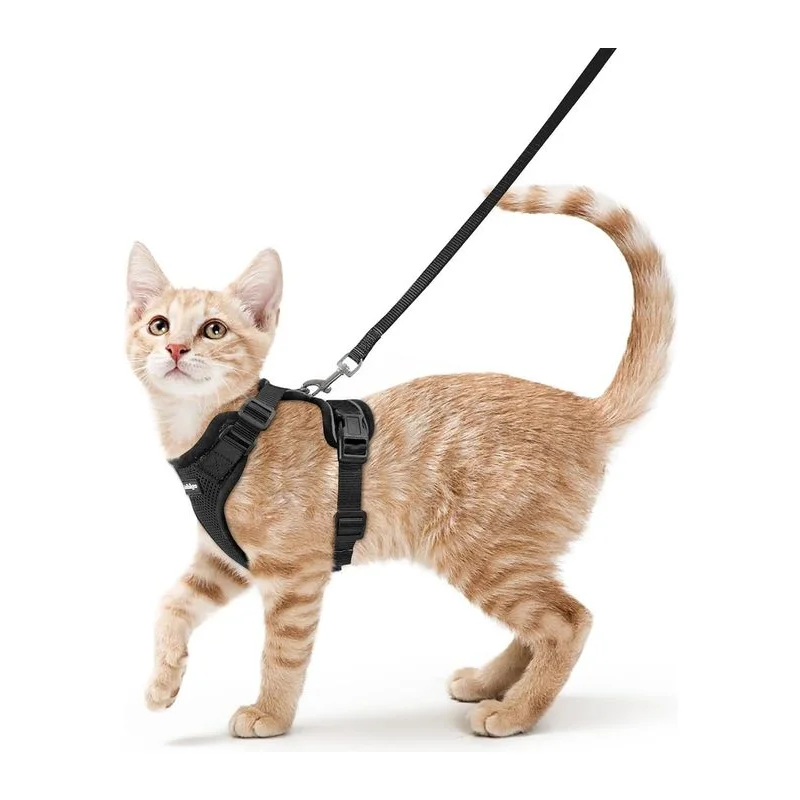
Best Overall: rabbitgoo Cat Harness and Leash Set
Best Overall Cat Harness
rabbitgoo Cat Harness and Leash Set
A soft air-mesh vest with four adjustable straps, two snap buckles, reflective strips and a leash ring on the back. Comes with a matching leash. Amazon's best-selling cat harness, in several sizes and many colours.
Buy on AmazonThe rabbitgoo Cat Harness and Leash Set is the one we’d try first on most cats. It’s a vest, which gives it more coverage than a strap harness, but light, breathable mesh keeps it from feeling like a coat. Four straps adjust the fit at the neck and chest, and you get a leash in the box, so it’s ready to use for less than $20.
It’s Amazon’s best-selling cat harness, with more than 65,000 ratings averaging 4.3 stars. In Cats.com’s hands-on test, the reviewer’s two harness-trained cats seemed most comfortable in this one.
Good to know:
- It goes over your cat’s head, and the neck strap doesn’t have much give, so you may need to loosen and tighten it each time. If your cat hates that, rabbitgoo sells a version with a neck buckle, or see the Voyager below.
- Sizes go by measurements, with chest ranges of 13.5–16 inches (34–41 cm) for XS, 18–20 inches (46–51 cm) for S and 21–25 inches (53–64 cm) for M on Amazon. Those ranges leave gaps, so a cat between sizes needs a different harness.
- The maker also gives a minimum head size for each harness. A cat with a small head for its neck can pull straight out, so measure the head too.
Best for Cats That Hate Things Over Their Heads: Voyager Step-In Air
Best Step-In Cat Harness
Voyager Step-In Air Cat Harness and Leash Set
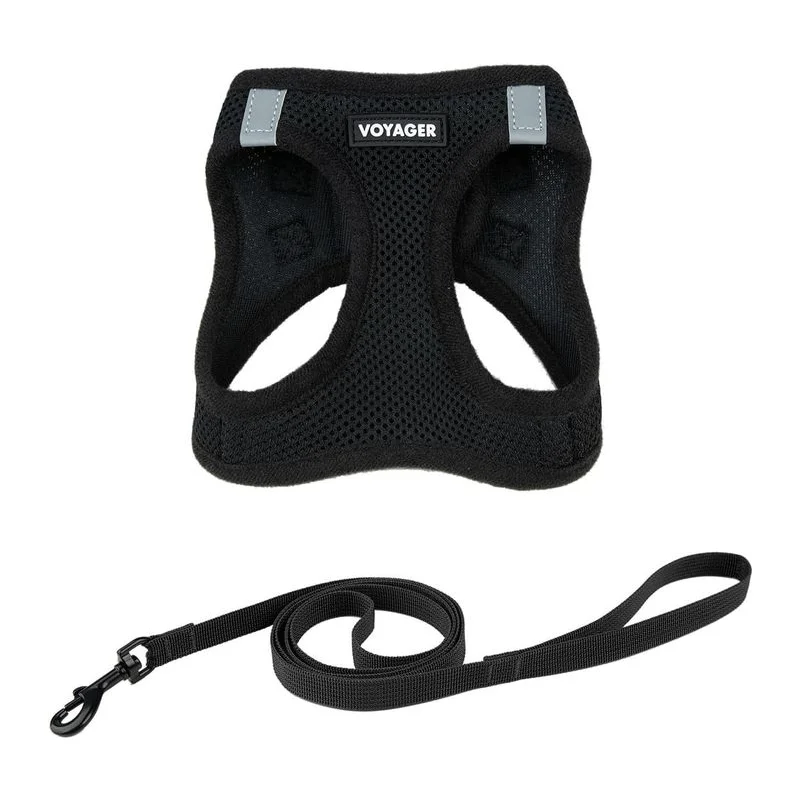
A padded air-mesh harness with a shaped neckline made for cats. Your cat steps in with its front legs and you fasten it on the back, with nothing to pull over its head. Comes with a matching leash, in many colours.
Buy on AmazonMany cats object most to the moment something goes over their ears. The Voyager Step-In Air skips that: lay it flat, put your cat’s front legs through the two holes, bring the sides up and fasten it on the back. It’s padded mesh with a neckline shaped for cats, and it comes with a matching leash for about $17.
It’s Cats.com’s top pick, and has a 4.6-star average from more than 2,300 ratings on Amazon, the best of our four picks.
Good to know:
- Size up if your cat is near the top of a range. Cats.com’s reviewer found the chest straps of the first one they ordered two inches shorter than listed, even fully stretched.
- Sizes are named by chest measurement on the listing, starting at 11–12 inches (28–30 cm) for XXXS. The S we link to fits 14–16 inches (36–41 cm), and the M, the largest we found, fits 15–17 inches (38–43 cm), so it isn’t for big cats.
- If it doesn’t sit snugly at the neck, return it and try another type.
Best for Wrigglers: Kitty Holster
Best Vest for Wrigglers
Kitty Holster Cat Harness
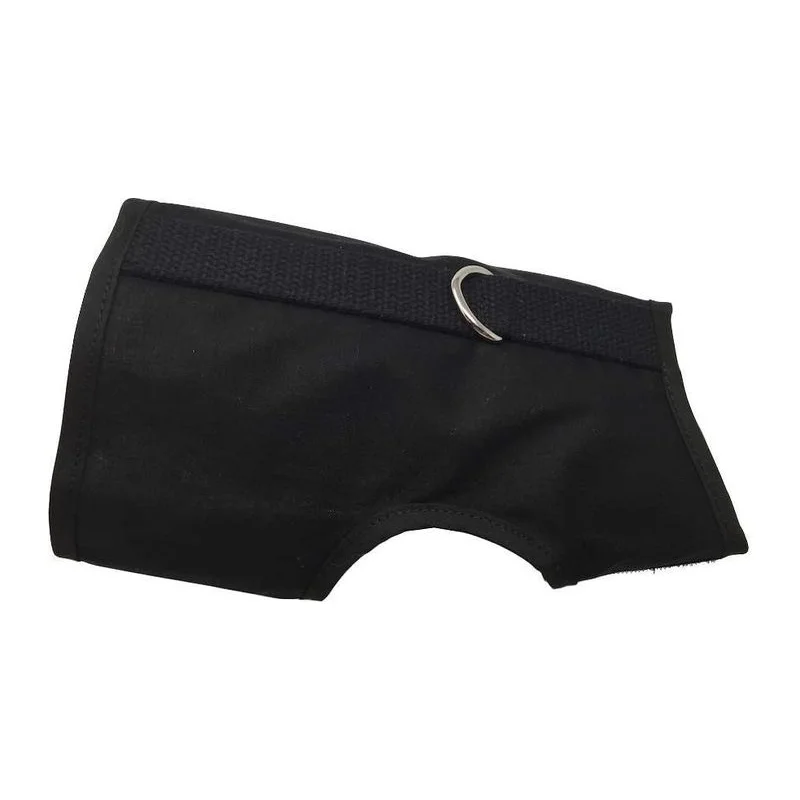
A soft cotton vest with wide hook-and-loop closures at the neck and chest, no plastic buckles, and a leash ring on the back. Made in the USA, in four sizes and several patterns, with a leash-training leaflet. Leash not included.
Buy on AmazonThe Kitty Holster is a different idea: a flat piece of soft cotton that wraps around your cat and closes with wide strips of hook-and-loop fastener. There are no buckles to wrestle with, and it goes on in seconds once your cat is used to it. Best Friends’ expert says Velcro vests are known to be quite safe and spread pressure evenly, and the wide closures let you adjust the fit to any point instead of along one strap.
It suits an owner who struggles with buckles as well as a cat that does. It has about 3,600 ratings on Amazon, averaging 4.4 stars, and comes with a leaflet on leash training.
Good to know:
- It’s the most expensive of our picks at about $28, and has no leash, so add a light one.
- Some cats just don’t like vests. In Cats.com’s test, one cat refused to walk in it and the other moved clumsily, especially when jumping. Try it indoors while you can still return it.
- Hook-and-loop gets weaker as it fills with fur, so clean it now and then and check that it still grips firmly.
- Sizes go by neck and chest: XS is 5–9 inches neck and 10–14 inches chest (13–23 and 25–36 cm), S/M is 9–12 and 13–17 (23–30 and 33–43 cm), M/L is 10–13 and 16–20 (25–33 and 41–51 cm), and XL is 11–15 and 19–23 (28–38 and 48–58 cm).
Best Strap Harness: PetSafe Come With Me Kitty
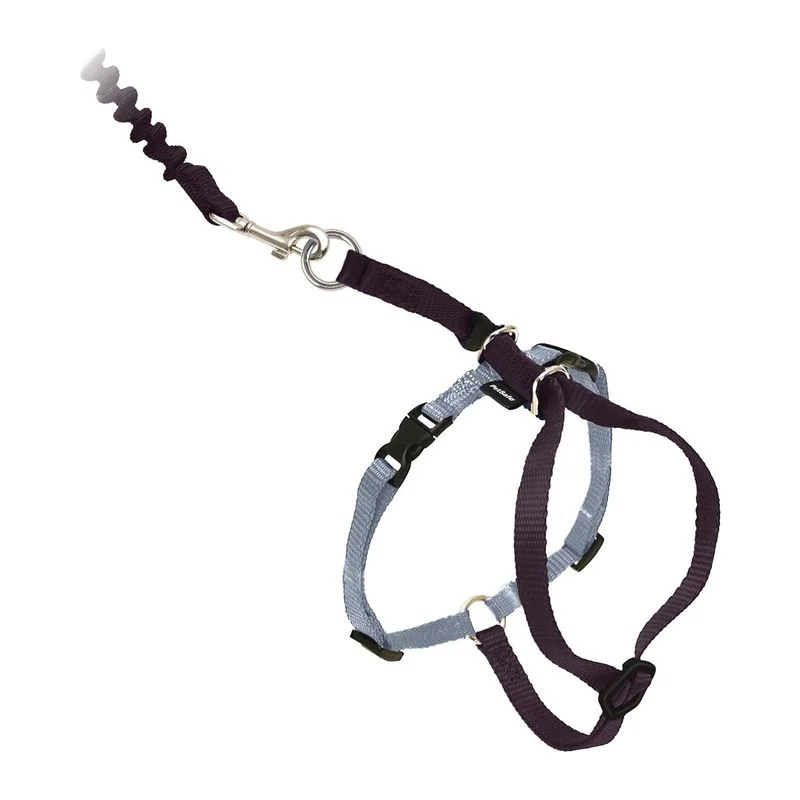
Best Strap Cat Harness
PetSafe Come With Me Kitty Harness and Bungee Leash
A light nylon strap harness that applies pressure to the shoulders instead of the throat, with several adjustment points and a stretchy bungee leash that softens sudden tugs. In small, medium and large.
Buy on AmazonIf your cat won’t move in a vest, a strap harness like the PetSafe Come With Me Kitty may be the answer, as it barely covers the body. It’s the one San Francisco SPCA names as an example in its training guide, and it has more than 12,000 ratings averaging 4.3 stars. The included bungee leash stretches a little, so your cat feels a gentle stop and not a sudden yank.
Cats.com ranks it second. The reviewer liked that even the strap between the shoulders adjusts, and said the harness is secure for cats that try to escape because everything can be tightened snugly. Both of their cats found it comfortable.
Good to know:
- That shoulder strap is made to tighten when a cat pulls, and the reviewer’s cats seemed uncomfortable with it. It’s a poor match for a cat that pulls hard.
- Thin straps are easier to back out of than a vest, says Cat School, a cat training site, so check the fit often.
- Sizes go by chest: 9–11 inches (23–28 cm) for small, 10.5–14 inches (27–36 cm) for medium and 13–18 inches (33–46 cm) for large. We link to the large, which the maker suggests for average and large cats, but measure first.
How to Measure Your Cat for a Harness
Don’t size by weight. Use a soft tape measure, and if you don’t have one, a piece of string and a ruler:
- Neck: measure around the base of the neck, where a collar would sit at its lowest.
- Chest: measure around the widest part of the ribcage, just behind the front legs.
- Head: some makers give a minimum head size, so measure around the widest part of the head as well.
Pick the size where both neck and chest fall in the range. If your cat is between sizes, read the notes above, since some harnesses run small. Kittens grow fast, so expect to buy more than one.
How to Put on a Cat Harness
Harnesses go on in three main ways. Whichever you have, do this somewhere quiet, away from the door, and only after your cat has done the training below.
Over-the-head vest, such as the rabbitgoo:
- Loosen the straps and undo the chest buckle.
- Hold a treat out so your cat stretches its neck forward, and slip the neck opening over its head.
- Bring the chest strap under the belly just behind the front legs, and clip it.
- Tighten the neck and chest straps evenly, and tuck in the loose ends.
Step-in harness, such as the Voyager:
- Lay it flat on the floor, with the leg holes facing up.
- Lift one front leg at a time and place it through a hole. It’s easiest with your cat standing between your knees, facing away from you.
- Bring the two sides up around the body, and fasten them on the back.
Wrap vest, such as the Kitty Holster:
- Lay it over your cat’s back, with the leash ring between the shoulder blades.
- Close the neck first, then wrap the chest closure around behind the front legs.
- Press along the full length of both closures so they grip.
Strap harness, such as the PetSafe: slip the neck loop over the head, then bring the other strap around behind the front legs and clip it. Adjust each strap so the ring sits on the back between the shoulder blades.
Check the Fit
- Use the two-finger rule. You should be able to slip two fingers between the harness and your cat, and no more. If more fit, it’s too loose. If two won’t fit, it’s too tight.
- Check every strap, not just one. A snug chest doesn’t help if the neck is loose.
- Try to ease it forward. Gently push the harness towards your cat’s head. If it starts to slide over the shoulders or the ears, tighten it, or try another size or type.
- Watch your cat walk. It should be able to move its shoulders freely, and straps shouldn’t rub behind the front legs.
- Check it again every time. Straps loosen, and cats gain and lose weight.
Take the harness off when you get back. Cats Protection says not to leave it on when you’re not walking your cat.
How to Harness Train a Cat
Best Friends’ plan has 13 small steps spread over at least 13 sessions, each no longer than four or five minutes. Some cats manage it in days, some take months, and some never get there. Find one treat your cat adores, and keep it only for training. This is the order, drawn from Best Friends and San Francisco SPCA:
- Leave the harness out. Put it near your cat’s food or favourite bed for several days, so it just smells like home.
- Touch it to your cat. Let your cat sniff it, give a treat, then lay it across your cat’s back for a moment and take it away. A piece of string and then a sock are good warm-ups for a nervous cat.
- Fasten it for a moment. Clip it on while your cat is eating a treat, then take it off before the treat runs out.
- Build up the time. Do this daily, and let your cat walk around indoors with the harness on, starting with a couple of minutes.
- Add the leash and let it drag. Do this in an open room with nothing to snag on, and keep your cat busy with treats or play.
- Pick up the leash. Hold it loosely and follow your cat around the house, wherever it goes.
- Teach it to follow you. Drop a treat, walk to the end of the leash, and reward your cat when it catches up. Never jerk or drag the leash.
- Go outside for a few minutes. Start somewhere quiet and just sit together. Fear Free suggests only a few minutes at a time at first.
If Your Cat Flops Over or Freezes
Fear Free says many owners give up the moment a cat flops over in its harness and refuses to get up. Don’t take it as the final word. Fear Free’s trick is to hold a favourite treat a few steps away, so your cat has to get up and walk to reach it. Fresh chicken works well. Go back a step if you need to, and end every session on a good note.
If your cat keeps panicking or trying to get the harness off after a few weeks of slow practice, stop. That’s an answer, and Best Friends’ expert says it isn’t a failure on your part.
How to Stay Safe Outside
Before the first walk:
- See your vet. Keep vaccinations and flea, tick and parasite prevention up to date. Cats Protection also advises neutering first.
- Microchip and label your cat. Check that the chip details are current, and add an ID tag. San Francisco SPCA, Best Friends and Cats Protection all make this a condition.
- Bring a carrier if you’re leaving home. Best Friends suggests a carrier as a quick retreat for a nervous cat, and SPCA New Zealand says a backpack can be useful in an emergency, but advises against the kind with a large clear bubble, because the cat has nowhere to hide and it can overheat.
On the walk:
- Start close to home. Your own yard or a quiet courtyard is ideal, and Fear Free says that’s already a richer life for your cat. Avoid busy streets, dog parks and popular trails.
- Let your cat lead. Best Friends’ expert says the leash is for safety, not steering. Most cats prefer 5 to 20 minutes, and many will mostly sit, sniff and lie in the sun. That’s a successful walk.
- Watch for dogs. Pick your cat up before a loose dog reaches it, since it can’t run away on a leash.
- Go in daylight. Fear Free says to avoid night, dusk and dawn, and to never go out on holidays with fireworks.
- Never tie your cat up. San Francisco SPCA says not even for a minute or two: your cat could get tangled, and it can’t escape if a dog comes along.
- Mind the ground and the heat. Hot pavement can burn paws, so test it with the back of your hand. Keep your cat away from plants and anything sprayed; our cat-safe plant list shows which common plants are dangerous.
- Respect wildlife. Keep away from nesting birds, and check local rules. Some parks ban cats, and in New Zealand owners who take cats into national parks can be fined.
If your cat gets scared: signs include crouching low, trying to hide, a tightly tucked tail, crying, and darting away. Keep the leash in your hand, don’t pull, and go to your cat. Pick it up calmly if you can, or wrap it in a towel if it’s frantic, then go home. Don’t make it stay out. Best Friends’ advice is to bring a distressed cat back inside as soon as possible.
If your cat slips the harness: don’t chase it, since that can drive a frightened cat further away. Crouch down, talk quietly and offer the training treat. If it runs off, search close by and look under things first, and contact your local shelters and microchip company straight away.
Will Walks Make My Cat Want to Go Out All the Time?
They might. Cats.com’s reviewer warns that some cats try to escape once they find out how much fun it is outside, and that’s why some people choose not to harness train a cat that has never been out. San Francisco SPCA has three useful rules:
- Carry your cat out. Put the harness on away from the door and carry your cat through it. If it walks out by itself, it may learn to dash out between walks without a harness.
- Don’t reward pestering. Never put the harness on while your cat is crying at you or the door. Wait until it’s quiet, and then go.
- Keep a regular schedule, so your cat knows when walks happen and pesters you less.
If Your Cat Doesn’t Take to It
Plenty of cats won’t, and they can live perfectly good lives without a walk. Best Friends suggests a cat stroller for cats that are only mildly uneasy outside, a bed near a window for cats that are very uncomfortable, and an enclosed catio for safe time outdoors. Every one of those beats a frightened cat on a leash. For indoor ideas, see our guides to the best window perches, best cat trees and best cat wheels.
Cat Harnesses in Short
Start by deciding whether your cat is the confident kind. If it is, measure its neck and chest, and buy a harness made for cats: the rabbitgoo suits most cats, the Voyager suits cats that hate things over their heads, the Kitty Holster suits wrigglers, and the PetSafe suits cats that won’t move in a vest. Fit it with the two-finger rule, spend weeks getting your cat used to it indoors, and keep the first trips short, quiet and close to home. No harness is escape-proof, so get a microchip and an ID tag first, and bring your cat home at the first sign of fear. If your cat is new, our checklist of everything you need before adopting a cat covers the rest of the essentials.