Most cats see their carrier a few times a year, and almost always on the way to somewhere they don’t want to go. A good carrier makes that easier: it opens from the top so you can lower your cat in instead of pushing them through a door, it comes apart at the vet so they can be examined without being dragged out, and it is sturdy enough that you don’t worry about it on the way. A bad one has a single small door, a weak zip, and a floor that sags in the middle.
We compared carriers on how they open, whether the top comes off, how sturdy and escape-proof they are, how easy they are to clean, whether they fit under an airplane seat, and what owners report after years of use. These are the ones we recommend.
- Best overall: the Petmate Two Door Top Load, a hard plastic carrier with a top door and a front door, made in the USA.
- Best for flying: the Sherpa Original Deluxe, a soft carrier that squashes under airplane seats, with a guarantee if the airline turns it away.
- Best for the car: the Sleepypod Air, a crash-tested carrier that also fits under airplane seats.
- Best for large cats: the SportPet X-Large, a roomy hard carrier with a wide door that folds flat when you don’t need it.
- Best budget: the Henkelion Cat Carrier, a light soft carrier for less than $25.
Why the Carrier Matters
The carrier is part of why so many cats miss vet visits. In a survey of more than 2,000 American pet owners, 40% of cats hadn’t seen a vet in the past year, against 15% of dogs, and owners described cats who hid when the carrier came out, fought being put in, and cried all the way there. The feline veterinary guidelines on handling list getting the cat into the carrier and the drive to the clinic among the reasons owners give for going less often.
It doesn’t have to be that way. In a randomised trial of 22 cats, six weeks of short, reward-based carrier training reduced stress on the journey and shortened the examination at the end of it. A carrier that is easy to load and comes apart at the vet also helps, which is why the advice below starts with how it opens.
What Makes a Good Cat Carrier
It opens from the top, and the top comes off. The American Association of Feline Practitioners recommends hard carriers that open from the top and the front and come apart in the middle. Lowering a cat in from above is far easier than pushing a reluctant one through a door at the end, and at the vet, a top that lifts off lets a frightened cat stay in the bottom half to be examined instead of being pulled out.
It is sturdy and escape-proof. Hard plastic carriers hold their shape, are hard for a cat to break out of, and wipe clean. Soft carriers are lighter and fit under airplane seats, but they need a firm floor, a frame that holds its shape, and zips that lock or clip shut, because cats learn to push them open.
It is the right size. Your cat should be able to stand, sit up, turn around and lie down in a natural position. Bigger isn’t always better, because a cat slides about in a carrier that is too large. Don’t size by weight alone: a long cat needs a long carrier, whatever the label says.
One cat per carrier. Even cats who get on at home can turn on each other when they are frightened in a small space, and both the feline vets’ association and International Cat Care say to give each cat its own carrier.
It is easy to clean. Accidents happen on the way to the vet. A waterproof base, a removable washable pad, and a shell you can rinse save a lot of trouble.
Best Overall: Petmate Two Door Top Load
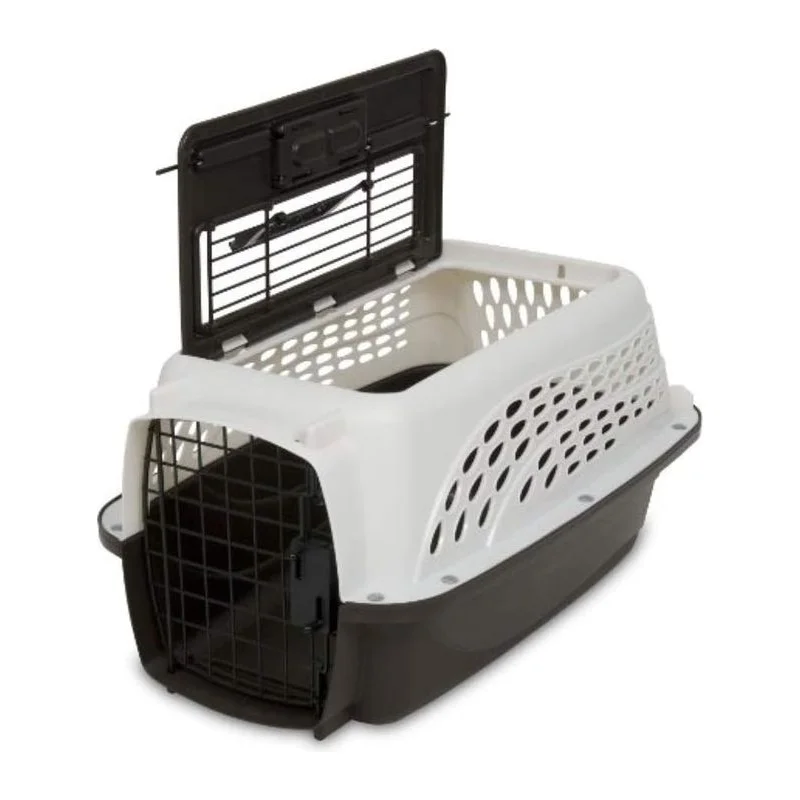
Best Overall Cat Carrier
Petmate Two Door Top Load
A hard plastic carrier with a top door and a steel front door, squeeze latches, a fold-down handle and a raised floor that keeps your cat dry. Made in the USA from recycled plastic, in 19-inch and 24-inch sizes.
Buy on AmazonThe Petmate Two Door Top Load is the carrier we’d give most cat owners. It has two ways in: a hinged door on top, for lowering your cat in from above, and a steel wire door at the front, for a cat who will walk in on their own. Both close with squeeze latches that a cat can’t nudge open. The shell is two halves that come apart, which owners say makes it easy to clean, and lets your vet take the top off if your cat won’t come out.
It is the shape and type of carrier vets tend to prefer: hard, well ventilated, with a flat floor and nothing for claws to snag on. A raised rim around the floor keeps a cat out of any accident, and the plastic wipes clean. Petmate makes it in the USA from recycled plastic, and it has more than 21,000 ratings on Amazon.
Good to know:
- It comes in two sizes. The 19-inch carrier suits small cats and kittens; most adult cats are more comfortable in the 24-inch one, which is about 24 by 17 inches and 14.5 inches tall.
- Hard carriers are heavier to carry than soft ones, and they don’t fit under airplane seats.
- No ordinary plastic carrier is built for a crash. In a 2015 crash test, a Petmate Vari Kennel broke apart and released the test dummy. Put a hard carrier on the floor behind a front seat, not on the seat.
- If you want something cheaper, the Amazon Basics 2-Door Top-Load carrier is a close copy for less, with more than 65,000 ratings. Its halves are screwed together, and its 19-inch size is small inside for a large cat.
Best for Flying: Sherpa Original Deluxe
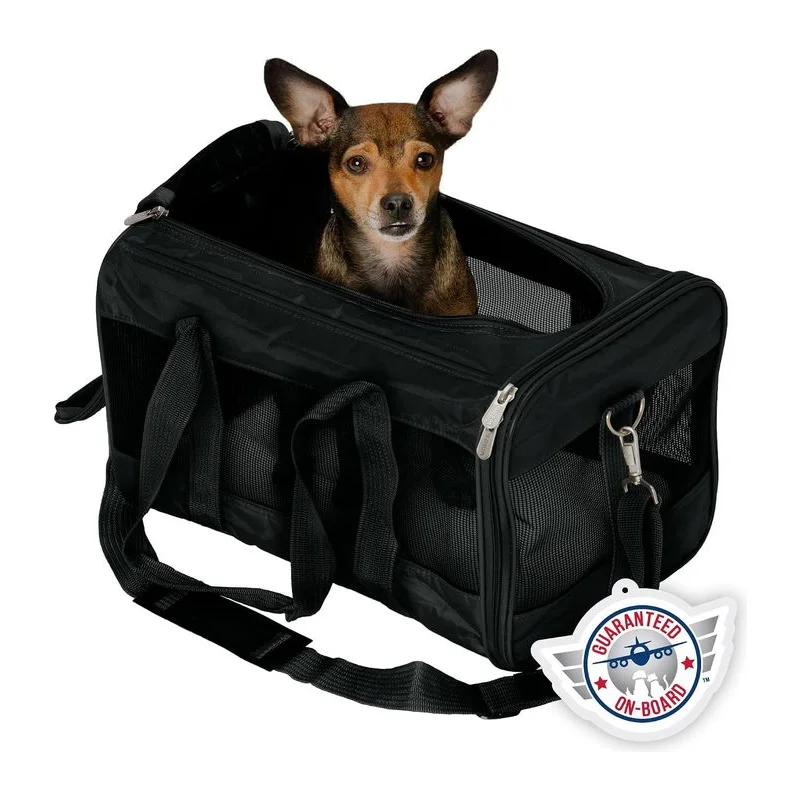
Best Cat Carrier for Flying
Sherpa Original Deluxe
A soft carrier with a spring-wire frame that compresses to fit under airplane seats, top and side doors, locking zips, a waterproof base, a washable liner, and Sherpa's Guaranteed On-Board program.
Buy on AmazonIf you fly with your cat, the Sherpa Original Deluxe has been on sale since 2004 and is one of the most familiar soft carriers for cabin travel. The frame is a spring wire that holds the carrier’s shape in the car, but lets you push the back end down by a few inches to fit under the seat in front of you. It opens from the top and the side, the zips lock, the base is waterproof, and the fleece liner goes in the washing machine. A strap on the back slides over a suitcase handle or takes a car seat belt.
Its best feature is the Guaranteed On-Board program. You register each flight on Sherpa’s site and print the confirmation, and if the airline refuses your cat because of the carrier’s size, Sherpa refunds the flight and the pet fee. It covers domestic flights in the USA and Canada.
Good to know:
- The medium is 17 by 11 inches and 10.5 inches tall, and fits most airlines’ cabin limits. The large is bigger than some airlines allow, so check your airline first.
- The guarantee covers size only. It doesn’t apply if you miss the paperwork, the gate agent’s signature, or the flight.
- Like any soft carrier, it gives less protection than a hard shell in a fall or a crash.
- The SturdiBag Pro 2.0 from our adoption checklist is a sturdier soft carrier with clips that lock the zips and an inside tether.
Best for the Car: Sleepypod Air
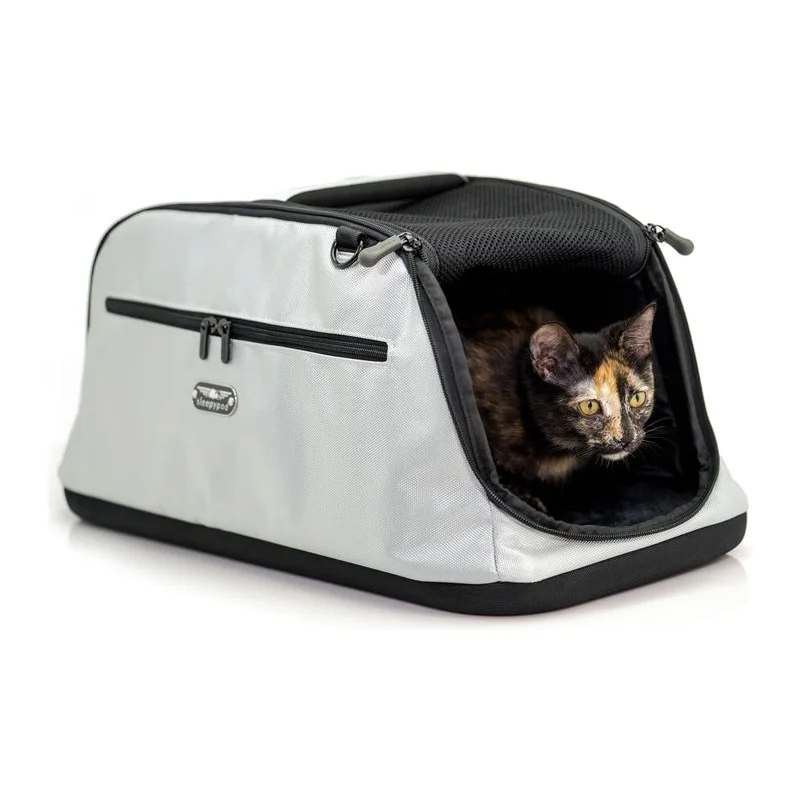
Best Cat Carrier for the Car
Sleepypod Air
A crash-tested soft carrier that straps in with the car's seat belt, compresses to fit under airplane seats, opens at the top and both ends, and comes with plush washable bedding. For cats up to 17.5 pounds.
Buy on AmazonThe Sleepypod Air is one of the few carriers that has passed an independent crash test. The Center for Pet Safety, a US nonprofit, crash-tests carriers at 30 mph, and in its 2015 study none of the eight products passed as they were sold, including several marketed as crash-tested. The Sleepypod Air earned the group’s certification in January 2025, with four stars at an 18-pound test weight. It is buckled in with the car’s own seat belt, following Sleepypod’s instructions.
It is also an airline carrier. Squeezed down, it goes from 22 inches long to 16 to fit under the seat in front of you, then expands again so your cat can stretch out at the gate. It opens at the top and at both ends, the shell is luggage-grade nylon, and the plush bedding goes in the washing machine. Sleepypod says it fits pets up to 17.5 pounds.
Good to know:
- It costs about $200, far more than our other picks.
- The crash rating only holds if you buckle it in exactly as Sleepypod shows. A carrier on a seat without the belt is no safer than any other.
- Its soft sides don’t come apart like a hard carrier’s, though the top opens wide for the vet.
- Sleepypod’s round Mobile Pet Bed, made for the car rather than for flying, earned five stars if you only need a carrier for the car.
Best for Large Cats: SportPet X-Large
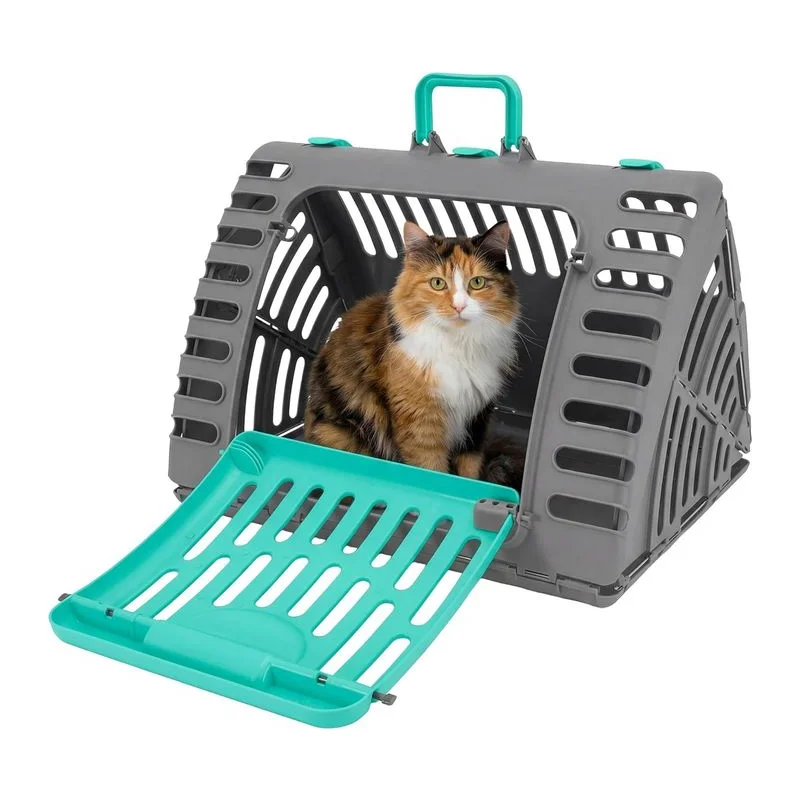
Best Cat Carrier for Large Cats
SportPet X-Large Cat Carrier
A roomy hard carrier, about 23 by 18 inches and 17 inches tall, with a wide door that opens the whole side and a shell that folds flat for storage. For pets up to 35 pounds.
Buy on AmazonMaine Coons, Ragdolls and other big cats often don’t fit in a standard carrier, and the large dog crates that do are hard to carry. The SportPet X-Large is built for cats. It is about 23 inches long, and its door is the whole side of the carrier, which swings down so your cat can walk in rather than be pushed. When you are done, it folds flat to slide behind a sofa or into a closet. In October 2026 it was the best-selling hard cat carrier on Amazon.
Good to know:
- The door is on the side, not the top, so you can’t lower a cat in from above. A cat who hates the carrier is easier to coax through a wide side door than a small front one, though.
- It is big. Measure the space behind your car seat before you buy.
- If your cat is large but not huge, the SportPet Large, about 18.5 inches long, comes with a removable bed and costs less.
Best Budget: Henkelion Cat Carrier
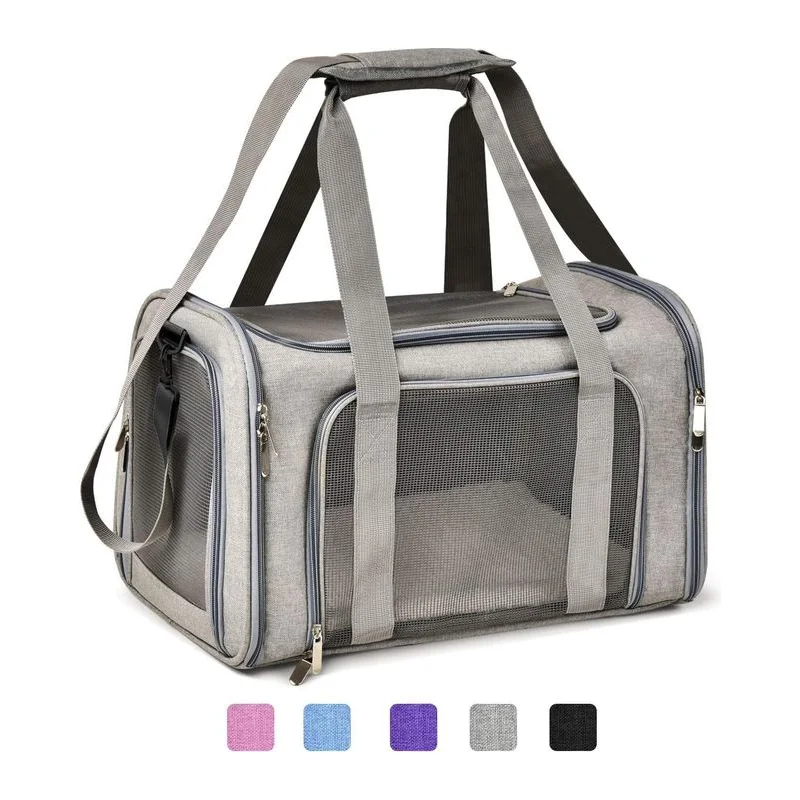
Best Budget Cat Carrier
Henkelion Cat Carrier
A light soft carrier, 17 by 11 by 11 inches, with mesh on four sides, top and side openings, a shoulder strap and a loop for a car seat belt. For cats up to about 15 pounds.
Buy on AmazonThe Henkelion Cat Carrier is one of the best-selling soft carriers on Amazon, with more than 53,000 ratings, and it costs less than $25. It is light, it folds away, and it opens from the top as well as the side. Mesh on four sides keeps air moving and lets your cat see out. At 17 by 11 by 11 inches, it fits under many airplane seats, though not every airline’s.
Good to know:
- It is less rigid than the Sherpa, so support the floor with a hand when you carry a heavy cat.
- Unlike the Sherpa, it doesn’t have locking zips. A determined cat can push a zip open, so close the zips where your cat can’t reach them and keep it zipped until you are indoors.
- Henkelion says the medium fits pets up to 15 pounds and 15 by 9 by 9 inches. Go by your cat’s length and height, not weight.
What About Cat Backpacks?
Backpacks with a round window are popular, and they free your hands for a walk or a bike ride. They are not a good fit for every cat. International Cat Care warns that backpacks can be unpleasant for cats that can’t hide, and a clear bubble leaves a nervous cat nowhere to go, and in sun it can heat up fast. If you want one, the PETKIT Cat Backpack has a tinted window that cuts glare, a fan you power from a power bank, and room for cats up to 17 pounds. Try it at home first, never leave it in the sun, and use a regular carrier for the vet.

Best Cat Backpack
PETKIT Cat Backpack
A hard-shell backpack carrier with a tinted window, a built-in fan you power from a power bank, a light, and a padded back plate. For cats up to 17 pounds.
Buy on AmazonHow to Get Your Cat Into a Carrier
Make it part of the furniture. Leave the carrier out, open, in a room where your cat spends time, with a blanket or an old T-shirt that smells of home. Drop treats in it, and feed your cat next to it, then in it. A carrier that only appears before the vet soon means the vet.
Train in small steps. Reward your cat for sniffing the carrier, then stepping in, then sitting inside with the door closed, then being lifted, then a short drive around the block. In the trial above, cats had 28 short sessions over six weeks. Stop each session before your cat gets uneasy.
On the day, don’t chase. Start in a small room with few hiding places. With a top-loading carrier, cradle your cat and lower them in, or take the top off, put your cat in the bottom half, and put the top back on. A cat who panics is easier to handle wrapped in a thick towel that smells familiar.
Carry it like a box of glasses. Cover the carrier with a towel so your cat can’t see out, and carry it with both arms from underneath rather than swinging it by the handle.
Secure it in the car. Put it on the floor behind a front seat, or buckle it in with the seat belt if it is a crash-tested carrier, and never put it in the trunk. Drive gently, and keep the radio low.
At the vet, ask for the top to come off. The feline handling guidelines recommend examining a nervous cat in the bottom half of the carrier rather than tipping them out. If your cat is very stressed by travel, ask your vet about medication before the visit. In a trial of 20 cats, gabapentin given before the trip lowered stress scores on the journey and during the exam.
Flying With a Cat
“Airline approved” on a listing is a sales claim, not a certification. The airline industry body IATA doesn’t approve any carrier, and each airline sets its own limits, which can change with the aircraft. When we checked in October 2026, the big US airlines allowed a cat in the cabin on these terms:
Airline | Carrier size | Fee each way | Pets |
|---|---|---|---|
Delta | 18 × 11 × 11 in, soft-sided recommended | $150 | 1 per carrier, or 2 of the same size aged 8 weeks to 6 months |
United | 18 × 11 × 11 in soft, 17.5 × 12 × 9 in hard | $150 | A second pet needs its own seat |
American | 18 × 11 × 11 in soft, 19 × 13 × 9 in hard | $150 | 1 carrier, as your carry-on |
Southwest | 18 × 10.5 × 10 in | $125 | Up to 2 small cats per carrier |
Alaska | 17 × 11 × 9.5 in, soft-sided only | $100 | Up to 2 of similar size per carrier |
The carrier usually takes the place of a carry-on bag, and it stays under the seat for the whole flight. A soft carrier that squashes down, like the Sherpa or the Sleepypod Air, is the safest choice, because the space under the seat varies from plane to plane. Even where an airline allows two cats in one carrier, give each cat its own. Check your airline’s page again before you book, since fees and sizes change.
How to Choose
For vet visits and the car, get the Petmate Two Door Top Load, in the 24-inch size for most adult cats. It opens from the top, comes apart at the vet, and lasts for years. If you fly, add the Sherpa Original Deluxe, the safest bet for getting on board. If you drive long distances, the crash-tested Sleepypod Air is worth the price. For a very large cat, get the SportPet X-Large, and if you just need something light and cheap, the Henkelion does the job.
Whatever you buy, buy it before you need it, and leave it out where your cat can get used to it. If you’re setting up for a new cat, our checklist of everything you need before adopting a cat covers the rest. For when you’re away, see our guides to the best automatic cat feeders and best self-cleaning litter boxes.