A self-cleaning litter box sifts the waste out after every visit and drops it into a sealed drawer, so you empty a bag every week or two instead of scooping every day. A good one does this quietly and reliably, stops the moment a cat comes near, and is easy to keep clean. A bad one jams, leaks urine under the litter bed, scares the cat off, or keeps cycling when it shouldn’t.
They are also expensive and a lot to fit in a room, so it’s worth choosing carefully. We compared the best-known models on how they sift, which safety sensors they have, which cats they suit, how often the drawer needs emptying, what they cost to run, and what owners report after months of use. Four stood out.
- Best overall: the Whisker Litter-Robot 4, the most proven self-cleaning box, with a scale that weighs each cat.
- Best value: the PETKIT PuraMax 2, a well-sealed box with a low entrance for well under half the price.
- Best open-top: the Neakasa M1 Plus, for large cats and cats who won’t go into a hooded box.
- Best budget: the PetSafe ScoopFree Crystal Pro, a rake that sweeps waste into a covered trough in a disposable tray of crystal litter.
Do Cats Like Self-Cleaning Boxes?
Nobody has studied automatic boxes directly, but research on ordinary litter boxes points both ways. Cats prefer a clean box to a dirty one, and in that study what put them off was the sight of clumps left behind rather than their smell. A box that clears the clumps minutes after each visit is good at exactly that. In a study of 28 cats, most had no preference between covered and uncovered boxes, though a few cared strongly either way, so a hooded globe suits most cats and an open-top box suits the rest.
Two things count against them. Cats like room: given a choice at home, 74 cats used extra-large boxes far more than regular ones, and the litter bed inside a globe or drum is smaller than a big plain box. And a box that moves and hums is new and strange. Battersea warns that some cats are put off automatic trays by the noise, the movement or the smell, and the feline veterinary guidelines on house-soiling note that a cat may avoid its box once it links it with a bad experience. Most cats adapt, especially if you introduce the box slowly, but some never do, so buy from a seller with a decent return window.
What Makes a Good Self-Cleaning Litter Box
It can’t close on your cat. This matters more than anything else on the list. Look for a box whose entrance stays open while it turns, or an open-top design, plus weight sensors and sensors at the entrance that stop the cycle when a cat comes near.
It suits your cat’s weight. Weight sensors only work above a minimum, usually 3 to 3.3 pounds. Kittens lighter than that can be inside without the box knowing. Big cats need a wide entrance and a high enough interior to turn around in.
It sifts cleanly and seals well. The drawer should close tightly, ideally with a carbon filter or a seal, and the base should keep urine from running under the litter bed, a common source of smell.
The drawer is big enough and the bags are cheap. A bigger drawer means fewer trips to the trash. Check whether the box needs its own bags, deodorizer or trays, because those costs add up over the years.
It has a real warranty and support. These are machines with motors and sensors, and some fail. Brands with long warranties, spare parts and firmware updates are worth paying for.
Best Overall: Whisker Litter-Robot 4
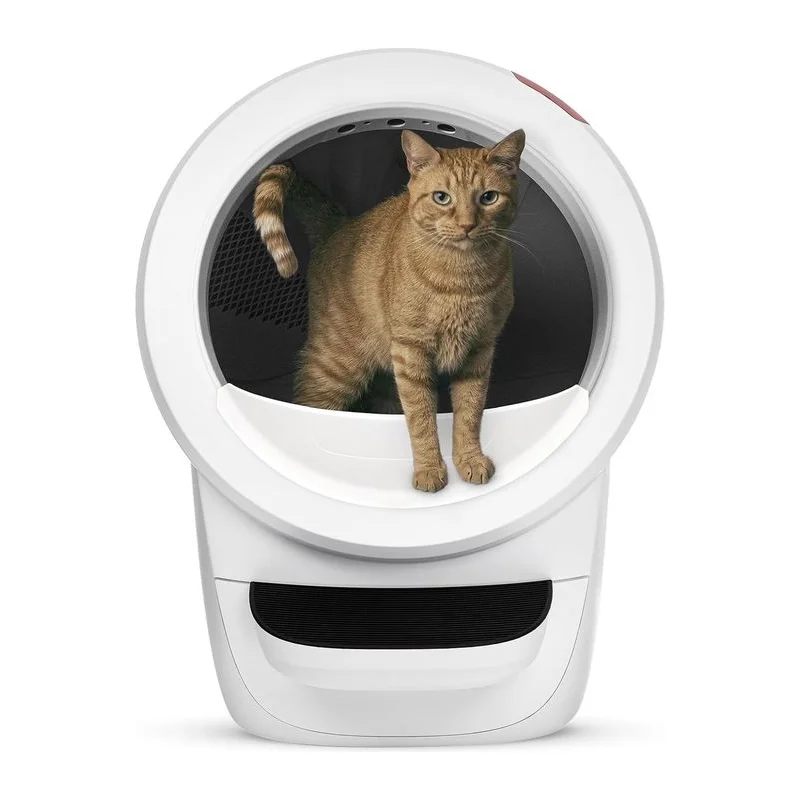
Best Overall Self-Cleaning Litter Box
Whisker Litter-Robot 4
A rotating globe that sifts clumps into a sealed drawer after every visit, with laser and weight sensors, a scale that weighs each cat, and app alerts when the drawer is full. For cats from 3 to 25 pounds.
Buy on AmazonThe Litter-Robot 4 is the one the others are measured against. Whisker has made the Litter-Robot since 2000, and the fourth version has been on sale since 2022. A few minutes after your cat leaves, the globe turns slowly, a screen lets the clean litter through, and the clumps drop into a drawer in the base, which is sealed and has a carbon filter. You set the delay in the app, from a few minutes up to half an hour, which helps with cats who come back to finish.
It knows when a cat is inside from a weight scale in the base and a row of laser sensors in the entrance, which Whisker calls OmniSense, and the same sensors tell the app how full the drawer is and how much litter is left. The scale records your cat’s weight at every visit. The app shows a week of visits and weights for free; longer history needs a Whisker+ subscription. The entrance is 15.75 inches wide, and Whisker says it suits cats from 3 to 25 pounds, including Maine Coons, and up to four cats. It works with any clumping litter.
Good to know:
- It is big: 24 by 24 inches and 31 inches tall, and the globe needs a little space on every side to turn. Whisker says it must not touch a wall.
- Each cat must weigh at least 3 pounds to use the automatic cycle safely, because the scale may not register a lighter kitten. Whisker says to use the semi-automatic mode until then.
- Put it on a hard floor. The scale is less accurate on carpet.
- The Amazon listing comes with Whisker’s one-year warranty and a 90-day return window. Whisker sells longer warranties.
- Whisker’s newer Litter-Robot 5 and 5 Pro, which add cameras, launched in November 2025 and in October 2026 were sold on Whisker’s own site rather than on Amazon.
Best Value: PETKIT PuraMax 2
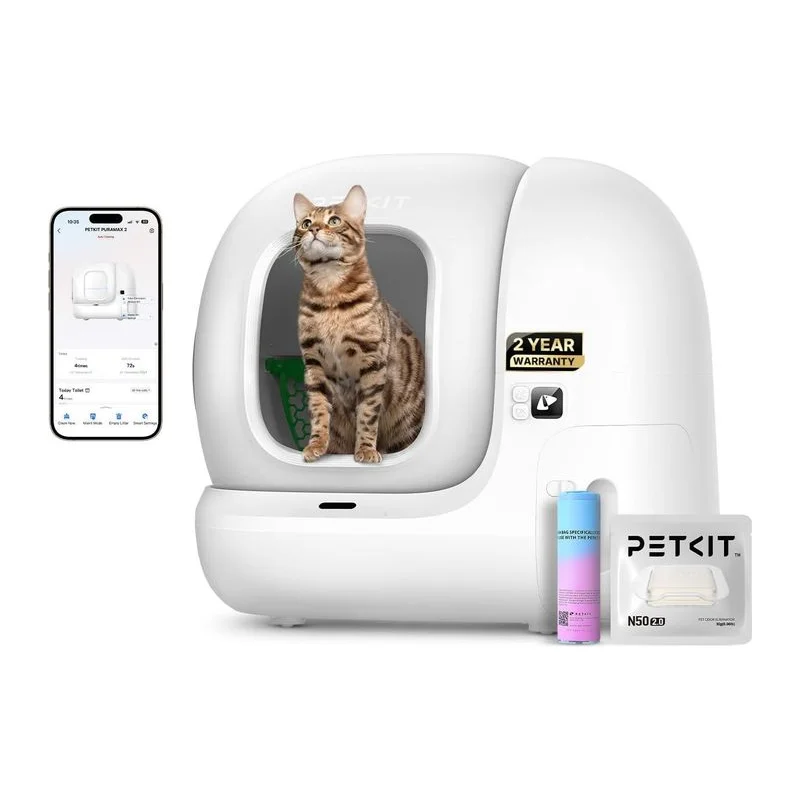
Best Value Self-Cleaning Litter Box
PETKIT PuraMax 2
A large hooded drum with an entrance 7.87 inches off the floor, 7 infrared and 4 weight sensors, an entrance that stays open while it turns, a sealed 7-liter waste bin and a two-year warranty. For cats from 3.3 to 22 pounds.
Buy on AmazonThe PETKIT PuraMax 2 does most of what the Litter-Robot does for well under half the price, and it is one of the best-selling self-cleaning boxes on Amazon, with thousands of ratings. A drum turns after each visit, sifts the clumps out and drops them into a sealed 7-liter bin, which PETKIT says lasts up to 15 days for one cat. A liquid deodorizer, the N50, sits in the bin.
PETKIT built the second version around stopping leaks, a common problem with drum boxes, where urine seeps under the litter bed: it has a sealed base and a fitted pad with raised edges. Seven infrared sensors and four weight sensors watch the entrance and the inside, and the opening stays clear while the drum turns, so a cat can’t be closed in. The entrance is only 7.87 inches off the floor, which suits older cats and short-legged breeds. The app identifies each cat by weight and logs visits and how long they take.
Good to know:
- It is for cats from 3.3 to 22 pounds, and PETKIT says not to use it with kittens under six months.
- It needs a flat, hard floor. PETKIT warns that carpet and mats can confuse the sensors.
- It only connects to 2.4 GHz Wi-Fi.
- The deodorizer refills and the fitted bags are an ongoing cost, though generic bags fit.
- In October 2026 PETKIT’s own store had moved on to the newer Purobot Max 3, but the PuraMax 2 was still sold on Amazon by PETKIT.
Best Open-Top: Neakasa M1 Plus
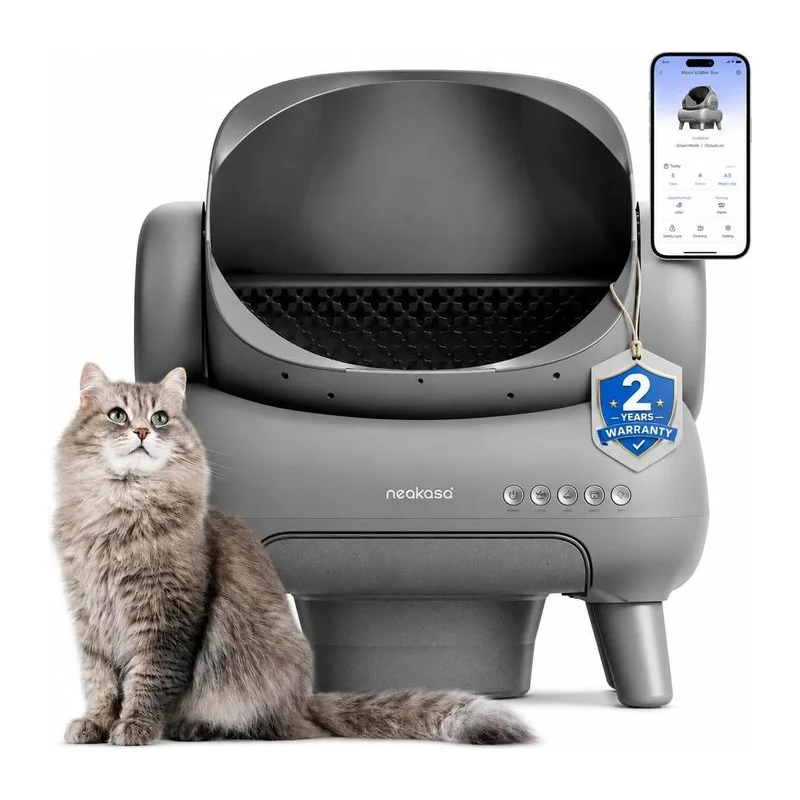
Best Open-Top Self-Cleaning Litter Box
Neakasa M1 Plus
An open-top litter bed that tips its waste into an 11.2-liter bin behind it, with rotating infrared sensors, a kitten mode, and room for cats up to 33 pounds. Comes with a two-year warranty.
Buy on AmazonSome cats won’t walk into a hooded box, and some are simply too big for one. The Neakasa M1 Plus has no hood at all. Your cat uses an open bed, and when the cycle runs the bed tips back, sifts, and empties the clumps into a large bin behind it. That bin holds 11.2 liters, so Neakasa says one cat can go one to two weeks between emptyings.
Neakasa says it suits cats from 3.3 to 33 pounds and up to three cats, which covers almost any domestic breed, and a kitten mode in the app is meant for kittens under 3.3 pounds. Infrared sensors that rotate to scan the area, along with a gear that limits how far the bed can turn, stop the cycle when a cat comes near. It has more than 4,800 ratings on Amazon.
Good to know:
- An open top means more litter kicked out than a hooded box, so put the included mat in front of it.
- Neakasa lists a noise level of 50 decibels while it cleans.
- It connects to 2.4 GHz Wi-Fi only.
- Use a clumping litter that forms firm clumps. Loose clumps break up in the sifting.
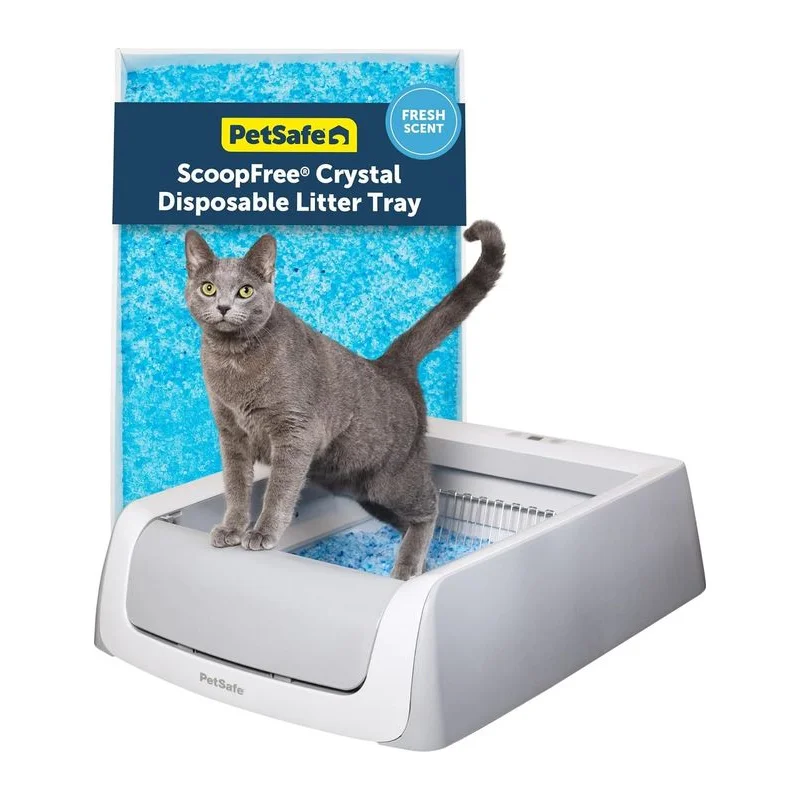
Best Budget: PetSafe ScoopFree Crystal Pro
Best Budget Self-Cleaning Litter Box
PetSafe ScoopFree Crystal Pro
A low, open box whose rake sweeps waste into a covered trough after every visit, using disposable trays of crystal litter that last about a month for one cat, with a counter that logs visits.
Buy on AmazonThe PetSafe ScoopFree Crystal Pro costs a fraction of the others and works differently. Instead of a turning drum and clumping litter, it uses a flat tray of silica crystals, which soak up urine and dry out solid waste. A while after your cat leaves, a rake crosses the box and pushes the waste into a covered trough at the end, and the timer starts again if your cat comes back. When the tray is used up, which PetSafe says takes about 30 days for one cat, you put the lid on it and throw the whole thing away.
It is low and open, so large cats and older cats get in easily, and it fits where a globe won’t. A counter on the front logs how many visits there have been, which helps you notice a change. It has more than 10,000 ratings on Amazon, and Amazon sells it directly.
Good to know:
- The trays are the real cost. A three-pack cost about $73 in October 2026, around $24 a month for one cat and more for several. PetSafe also sells a reusable tray you fill with loose crystals.
- The crystals don’t clump and feel different underfoot, and some cats won’t use them. Switch over gradually.
- Soft or loose stool smears on the rake. It suits one or two cats with normal digestion best.
- It has no app and doesn’t weigh your cat.
Which Litter to Use
Every box here except the ScoopFree needs a clumping litter, and the better it clumps, the better the box works. Firm, hard clumps roll off the screen and drop into the drawer whole. Soft clumps break up during the turn, smear the liner, and leave bits behind that smell. Fine, low-dust clumping clay is the safest choice, and an unscented one avoids putting off cats who dislike perfume. Boxie Probiotic, from our cat litter guide, forms flat, hard clumps that suit these boxes well. If you want a plant-based clumping litter such as tofu or corn, check the manual first: PETKIT, for one, ships the PuraMax 2 with a sifter meant for mineral litter.
Don’t use pellets, paper, pine or non-clumping clay in a drum or tipping box, and fill only to the line the manufacturer marks. Too much litter makes the motor work harder and spills into the drawer. The ScoopFree is the opposite: it takes only crystal litter, in PetSafe’s trays or loose in its reusable tray.
Are Self-Cleaning Litter Boxes Safe?
Mostly, but not all of them, and this is the main reason we stuck with established brands. Cats have died in automatic boxes. In July 2024 a cat called Mochi was found dead in an automatic box bought on Amazon, her neck caught when the door closed, according to her owner. The brand was later reported as Amztoy, and a reviewer who tested a similar unit found that its entrance closed fully during the cycle. In 2025 a couple in the Bronx sued PetPivot and Amazon after their cat Sarabi was found trapped in a PetPivot AutoScooper 11. PetPivot said it was the only serious incident among more than 100,000 units sold, and in February 2026 a federal judge let the false-advertising claims go ahead, which is not a finding of fault. When we checked in October 2026, we found no automatic litter box in the recall lists of the US Consumer Product Safety Commission or Health Canada.
Most of Amazon’s best-selling self-cleaning boxes are open-top models from brands you won’t have heard of, for $100 to $200. Some may be fine, but they have short track records, thin support, and safety sensors you can’t judge from a listing. A box that moves while your cat is in it is the one product where a weak sensor can hurt them. Whichever box you buy:
- Respect the weight limit. Don’t use the automatic cycle with kittens below the box’s minimum weight. PetSafe and PETKIT both say to wait until six months old.
- Watch the first few weeks. Check that the box stops when your cat steps in or comes near during a cycle, before you leave it running while you’re away.
- Keep the firmware updated. In one tested unit, a firmware update fixed a box that resumed its cycle after the sensor triggered.
- Buy from the brand’s own store or an authorized seller. Whisker warns that counterfeit Litter-Robots sold online put pets at risk and aren’t covered by its warranty.
- Keep it on a hard, level floor, away from walls if the manufacturer says so, with nothing blocking the entrance.
How to Introduce One
Go slowly. Put the new box next to the old one, filled with the litter your cat already uses, and leave it switched off or in manual mode for the first few days, so your cat gets used to it before it ever moves. PetSafe suggests keeping both boxes for at least a week. Run the first cycles yourself while your cat is in another room. Once your cat uses the new box reliably, turn on the automatic cycle, and take the old box away only when you’re sure. If you change litter at the same time, mix the new litter in gradually over about a week; in a study of 16 cats, a six-day switch didn’t change how they used the box.
Keep an Eye on What’s in the Drawer
The one real downside of not scooping is that you stop seeing what your cat leaves behind, and the litter box is where many illnesses show first. A cat with kidney disease or diabetes passes more urine, and a male cat with a blocked urethra passes little or none, which Cornell calls an absolute emergency that can kill within a day or two.
The apps partly make up for it. Owners are bad at noticing how often their cats go: in one study, video showed cats urinating about four times as often as their owners reported, and five of the 19 cats were never seen in the box at all. Small studies with litter-box monitors have found that cats with kidney disease defecate less often than healthy cats, so a visit count and weight log can flag a change. That research is early, small and mostly funded by pet food companies, and no study yet shows that app alerts lead to better outcomes.
So use the app, but don’t rely on it. Look in the drawer when you empty it, notice if the clumps get bigger or more frequent, and watch your cat. A cat that strains, goes in and out of the box without producing anything, or cries in the box needs a vet the same day, especially if it’s a male.
How to Choose
For most homes, get the Litter-Robot 4. It is the most proven design, it suits almost any adult cat, and its scale gives you a running record of your cat’s weight. If $699 is too much, the PETKIT PuraMax 2 does the same job for much less and has a lower entrance for older cats. If your cat is very large, or won’t use a hooded box, the open-top Neakasa M1 Plus is the one to try. If you have one cat and a small budget, the PetSafe ScoopFree costs least up front, as long as your cat accepts crystal litter and you budget for the trays.
For more on the box itself, including size and how many to have, see our guide to the best litter boxes, and for what to fill it with, the best cat litter. If you’re setting up for a new cat, our checklist of everything you need before adopting a cat covers the rest, and our best automatic cat feeders and best cat water fountains take care of food and water while you’re out.