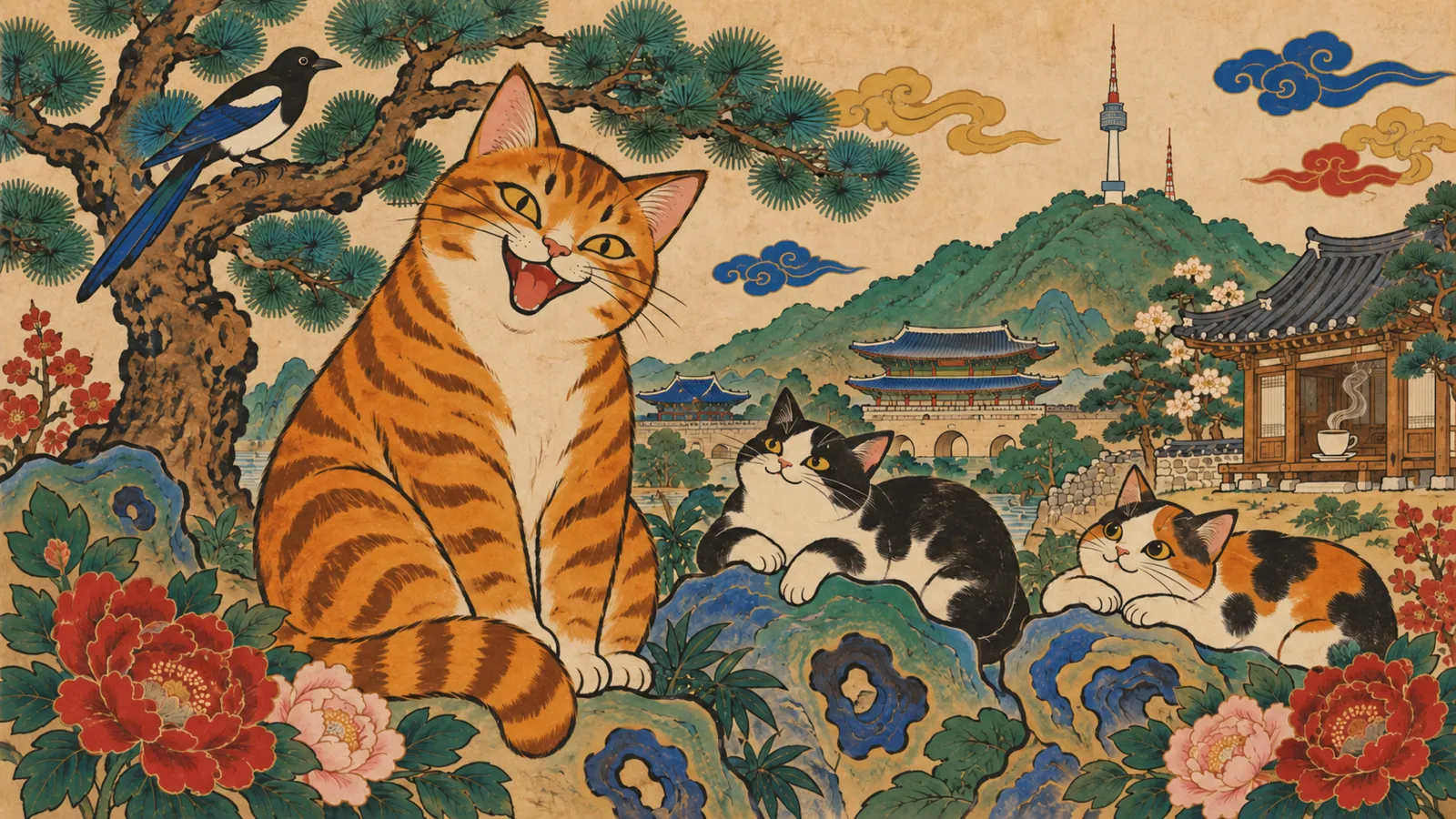
South Korea has one of the busiest cat café scenes in the world. Our directory lists more than 260 open ones, from a 50-cat lounge two minutes from Myeongdong station to a rescue shelter with a railway-station theme on an island off Incheon. Korea’s cat cafés appeared in Seoul in the late 2000s, a few years after Japan’s, and Y Cat in Hongdae, which calls itself the oldest still running, has been open since 2008. Since then the scene has split in two: big, bright themed cafés with dozens of pedigree cats, and small rescue cafés where every cat is waiting for a home.
Seoul has the most, packed into the same neighborhoods visitors already stay in, but every big city has a few, and some of the most memorable are outside the capital. We start with what to expect inside a Korean cat café and what it costs, then go city by city from Seoul to Jeju, and finish with Korea’s street cats and the rules on other animal cafés. Every price, closing day and age rule below comes from the café’s own Naver Place listing, website or social accounts as of October 2026.
How Cat Cafés Work in Korea
Korean cat cafés fall into three broad groups, and knowing which one you’re walking into tells you the price, the cats and the rules.
- Big themed cafés such as Roof Cat Me, Catple and Cat Cafe MOCHA have 20 to 70 young pedigree cats, bright interiors and long opening hours, usually noon to 9pm or 10pm. Entry is a ticket of about ₩12,000 to ₩20,000, often with a drink, and you can usually walk in.
- Rescue cafés take in abandoned, surrendered or injured street cats, and the entry fee pays for their food and vet bills. Jipsaui Haru (“a cat butler’s day”) has branches in Seoul, Busan and Daegu, Stray Cat Town has two in Seoul, and many smaller ones are run by a single rescuer. Expect ₩10,000 to ₩15,000. Adopting usually means an interview and local residence, so for visitors it is a way to support the cats rather than take one home.
- Small independent cafés often charge less, sometimes just a drink each (1인 1음료, “one drink per person”) or a ₩5,000 to ₩10,000 ticket, and the cats are the owner’s own.
Weekday visits often have no time limit, but at weekends and on holidays most cafés cap a visit at 90 minutes to two hours. Many have a minimum age: some ask only that children under 12 or 13 come with an adult, but others are no-kids zones (노키즈존) for anyone under 10, 13 or even 15, so check before you bring children. House rules are much the same everywhere: slippers or socks on, bags in a locker, hands sanitized, no picking up cats, no flash, and no waking cats that are asleep. Cats wearing a scarf usually shouldn’t be fed or handled.
Use Naver Map rather than Google Maps to find small cafés: it has an English interface, translated reviews and the most up-to-date hours. Most cafés are walk-in, and those that take bookings use Naver Booking. Since June 2026, visitors with a foreign passport can verify their identity on Naver and book without a Korean phone number. Bring a Visa or Mastercard; most cafés take cards, though Kakao Pay and Naver Pay still don’t work with foreign tourist accounts.
Korean law shapes what you’ll see. Any café that shows five or more dogs or cats must register with the local government as an “animal exhibition business” (동물전시업) and display its certificate and price list inside. The rules require a double door at the entrance, hand sanitizer, separate rest rooms with shelves and hiding places, and at least one carer for every 20 cats. Cats on display must be at least six months old and have a yearly health check, they can’t be on show for more than 10 hours a day, and they must be able to rest whenever they want. Exhibited cats also can’t be bred or sold, so a café that sells kittens is running a separate breeding or sales business alongside; we point those out below.
Korean Cat Cafés at a Glance
City | Easy walk-in | Rescue café | Something different |
|---|---|---|---|
Seoul | Cats’ Playground | Stray Cat Town | DCAT (all Ragdolls) |
Busan | Goyangi Darakbang Nampo | Jipsaui Haru Seomyeon | Arles |
Incheon | Butacat | Cat Bridge | Cat Station |
Suwon | Cat’s Fish Store | Haenggung Myoyeon | Catple I-Park City |
Daegu | Yaongah Nolja | Jipsaui Haru Dongseongno | Cats & Coffee (all Ragdolls) |
Daejeon | DAZE | Mione | Catple Cozy Nook |
Gwangju | Healing Nyaongi | Healing Nyaongi | Ddegururu (15 and over) |
Jeonju | Goem | Chunyangi House | — |
Gyeongju & Gangneung | Yaongah Nolja Gyeongju | Lazy Cat | Louis Cat |
Jeju | Mirdam | Mirdam | Jeju Cat World |
Prices below are in won and were checked in October 2026. Cafés change their prices and closing days often, and many post temporary closures only on Instagram, so check the café’s Naver listing before you go.
Seoul
Seoul has about 50 cat cafés, and most of the ones worth a visit are in four areas: Myeongdong, Hongdae and Sinchon, Gangnam, and Seongsu. Browse them all on our Seoul map. If you’re staying a few nights, Myeongdong is the easiest base: four cat cafés are within five minutes’ walk of its subway station, and the airport buses and Seoul Station are close by. Here are places to stay near Myeongdong station on Booking.com.
Myeongdong
Roof Cat Me Myeongdong is two minutes from exit 9 of Myeongdong station (Line 4), on the second floor of a building on Myeongdong 8ga-gil. It is one of the biggest in the city, with about 50 cats in a fairy-tale “rooftop cat village”, a drink bar and phone chargers for travelers. Entry is ₩20,000 for adults and ₩15,000 for children, with a drink, and weekend visits are limited to two hours. The cats are fed at 1:30pm, 4:30pm and 7:30pm, which is the liveliest time to be there. It opens noon to 10pm but closes on the first and third Monday of the month.
Cats’ Playground, two minutes from exit 8, is the easy choice: 50 to 60 cats, no time limit on any day, no age limit, and an English description on its Naver page. Adults pay ₩14,000 with a drink, ages two to 19 pay ₩12,000, and it is open every day from noon to 11pm, the latest in the area. Cat’s Sarangchae, four minutes from exit 8, opened in 2024 with an interior that mixes traditional hanok style with modern design, and its doorbell greets you in English. Entry is ₩14,000 for any age, with a drink, for 90 minutes, daily from noon to 10pm. Near Noon Square, Skycat Cafe has a walkway running high around the room and charges ₩13,000 for adults (₩11,000 for children) with a bottled drink or a cat treat and no time limit.
Hongdae and Sinchon
The university district around Hongik University station (Line 2, the airport railroad and the Gyeongui-Jungang Line) has Seoul’s thickest cluster of cat cafés. Roof Cat Me Hongdae, three minutes from exit 9, is the Myeongdong café’s sister, with 40-odd cats, the same prices and a feeding bell that sends every cat into its own cubby. It closes on alternate Mondays. Cat’s Attic Hongdae is the closest to the station, two minutes from exit 9, at ₩10,000 with a drink; it doesn’t admit preschool children.
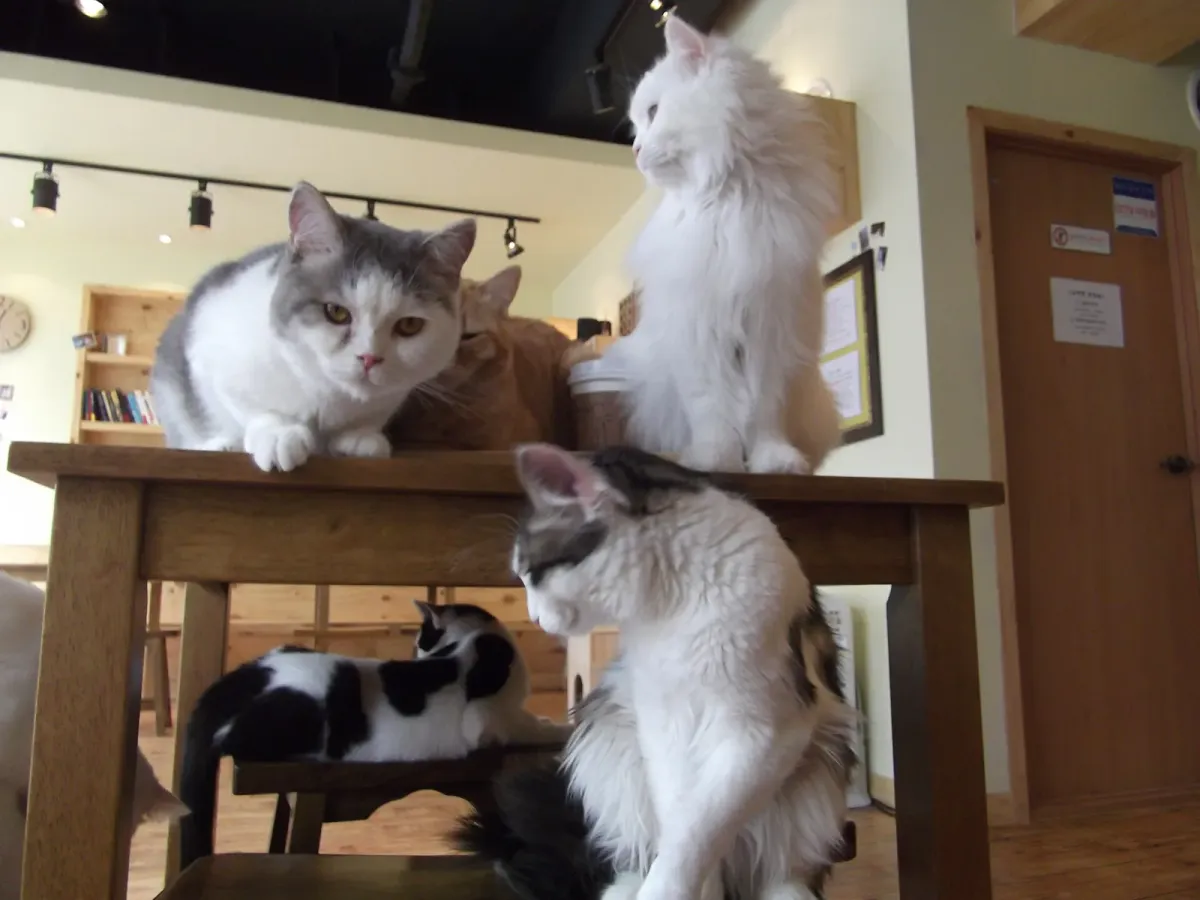 Photo: Mouselinguist, CC BY-SA 3.0, via Wikimedia Commons
Two of Seoul’s best rescue cafés face Hongdae Playground, about ten minutes from exit 9. Y Cat (Cheongchun Goyangi) opened in 2008, calls itself Korea’s oldest cat café, and is full of rescued and older cats, many of them happy to sit on a lap. Everyone pays ₩10,000 with no time limit, or ₩9,000 if you book on Naver; it opens 1pm to 8pm on weekdays and noon to 9pm at weekends. A few doors away, Jipsaui Haru Hongdae is the head branch of a self-funded rescue chain started in 2015 by a former animal-hospital worker. Its 20-odd cats, from Korean shorthairs to a Sphynx, are all up for adoption. Entry is ₩10,000, with drinks and treats extra, and visits are limited to 90 minutes when it is busy.
In Sinchon, one stop east, Cat’s Loft is an independent café on the third floor of the Burger King building near Yonsei University, four minutes from exit 2. Its name comes from the low mezzanine you can bump your head on, and the house rules are posted in English for the many foreign students. Entry is ₩10,000 with a drink, daily from noon to 10pm, with no time limit on weekdays; it doesn’t admit preschool children. Four minutes from exit 1, DCAT has only Ragdolls and charges ₩12,000 with an unlimited drink and snack bar. In Sangsu, Cat Paradise has a balcony for the cats and charges ₩15,000 with a drink (₩12,000 for children), with no time limit.
Gangnam
Three cafés sit together on Teheran-ro 1-gil, between exit 11 of Gangnam station and Sinnonhyeon station. Cat Cafe MOCHA Gangnam, the Korean branch of the Japanese chain, has 24 cats and works like its Japanese cafés: ₩10,000 for the first 30 minutes on weekdays (₩15,000 at weekends), then ₩2,000 per ten minutes, with unlimited drinks and a daily cap of ₩28,000 (₩38,000 at weekends). It is open every day from noon to 10pm, needs no booking, and doesn’t admit children under four.
On the same street, Jipsaui Haru Gangnam calls itself Gangnam’s only rescue-shelter café, with about 30 cats, some with visible health problems but very gentle. Entry is ₩10,000, with no time limit on weekdays and 90 minutes at weekends and on holidays. Up the hill behind the CGV cinema, Hihinyangnyang is the late option, open until 11pm, at ₩10,000 for 90 minutes; on weekdays it welcomes people who bring a laptop to work.
Seongsu, Konkuk and Jamsil
Stray Cat Town Seongsu is on the seventh floor of the Olive Young building a minute from exit 1 of Seongsu station. It is a rescue café for abandoned cats and for street cats too used to people to go back outside after neutering, with a foster room and a room of rescued rabbits and guinea pigs. A “one-day guardian” ticket costs ₩15,000, drinks are extra, and adoption is free after screening. Its sister Stray Cat Town Jamsil, nine minutes from exit 10 of Jamsil station, works the same way and is handy for Lotte World and Olympic Park. Both open 11am to 10pm on weekdays and 10am to 10pm at weekends.
Between Seoul Forest and Ttukseom, Nuzzle is a bright wooden room with 23 cats, on the fourth floor of a building with no lift, six minutes from exit 8 of Ttukseom station. Entry is ₩13,000 with a drink, with no time limit on weekdays and 90 minutes at weekends, and it admits only children aged about ten (fifth grade) and over. A minute from exit 5 of Konkuk University station, Woozoorocat has a space theme and a board giving each cat’s personality type, at ₩10,000 with no time limit.
Near Gimpo Airport, Purr Lounge is an adoption lounge in a company headquarters, one stop from the airport at Magongnaru station. A one-hour session for up to ten people starts with a ten-minute briefing and costs ₩24,000, which includes a donation and a drink at the café in the same building.
Busan
Busan’s cat cafés cluster in the same places as its sights. Around BIFF Square in Nampo, three are within 300 meters of each other, about three minutes from exit 7 of Jagalchi station, so they fit between Gukje Market and Jagalchi fish market. Yang2 Yang2 is the cheapest, at ₩9,000 for adults with a drink for 100 minutes, open daily from 12:30pm to 9pm; it is on the fourth floor, with no lift. Goyangi Darakbang Nampo has run for more than ten years, has many breeds and charges ₩10,000 with a drink. Jipsaui Haru Nampo is the rescue chain’s local branch, at ₩10,000 with drinks extra. Browse the rest on our Busan map.
The rescue chain has three more branches here. Jipsaui Haru Seomyeon, four minutes from exit 2 of Seomyeon station, is the most spacious, and staff talk to you through an intercom so the door stays shut; visits are 90 minutes. Jipsaui Haru Jeonpo is two minutes from exit 7 of Jeonpo station on the way to the Jeonpo café street, and Jipsaui Haru Gwangan is at the Gwangalli Beach intersection. All three open noon to 10pm on weekdays and from 11am at weekends.
By the beach, Cat Cafe PPP, in an underground pet arcade a minute from Gwangan station, lets you choose a family room with toys or a couple room with board games, comics and claw machines, at ₩13,000 with a drink for three hours on weekdays and two at weekends. At the Millak end of Gwangalli, Nyangnyang Nyungnyung has a flat, illustrated interior and charges ₩10,000 an hour. In Haeundae, Catch Catch, four minutes from exit 2 of Dongbaek station, opened in 2026 with long-haired breeds and charges ₩15,000 with a drink.
The most charming is Arles, a yellow two-storey house up on Dalmaji-gil above Haeundae, named after the town Van Gogh painted. An art studio runs downstairs and the cats live upstairs, with a yard. On weekdays ₩12,000 buys unlimited time; at weekends it is ₩12,000 an hour or ₩16,000 for two. It admits ages six and over, takes 15 visitors at a time and opens only Thursday to Sunday, 1pm to 8pm, so book on Naver. Near Busan City Hall, Cafe Berakah is a specialty coffee bar whose owner has rescued street cats for about nine years; the cat room costs ₩7,000 and is open to children from fourth grade.
Incheon
There is no cat café at Incheon Airport, on Yeongjong Island, in Songdo or in Chinatown, so plan on a short trip. Butacat, in the Alleyway Incheon mall nine minutes from exit 3 of Dohwa station, is the best value in the region: ₩11,000 buys four hours with a drink on weekdays (₩14,900 for two hours at weekends), with up to four hours of free parking. At Bupyeong station, Kongbokkneun Yaongi has a floor-seating room full of older cats at ₩10,000 with a drink, daily from 1pm to 10pm, but children 13 and under aren’t admitted. Cat Bridge, a minute from exit 2 of Wanjeong station in Geomdan, was set up by volunteers who had been paying for shelter cats’ treatment themselves; it closes on the first Tuesday of the month.
For a day out, Cat Station on Yeongheung Island, reached by road across the Daebu-do bridges, is a shelter for more than 100 abused, abandoned and disabled cats, styled as a railway station: your ticket goes through a real ticket gate, and “wanted poster” cats hide around the building for you to find. One hour costs ₩13,000 for adults and ₩7,000 for children (₩25,000 for the day), drinks are extra, and all the money goes on the cats’ care. It opens 11am to 6pm, but may close in heavy rain or snow, so phone first. Browse the rest on our Incheon map.
Suwon
Most visitors come to Suwon for Hwaseong Fortress, and only one cat café is in the fortress quarter. Haenggung Myoyeon, above a convenience store near Hwaseong Haenggung palace, opened in 2025 and keeps a blackboard of cats looking for homes. Entry is ₩12,000 for adults and ₩10,000 for under-18s, drinks are optional, and there is a two-hour limit at weekends. Near Suwon station, on the car-free Rodeo Street, Cat’s Fish Store has 27 cats on a sixth floor and charges ₩13,000 with a drink, daily from 11am to 10pm.
The big one is Catple I-Park City, nine minutes from exit 1 of Seryu station, one stop south of Suwon, which opened in February 2026 with about 70 cats, including Ragdolls, Maine Coons, Munchkins and Devon Rex. Three hours on a weekday costs ₩12,900 and two hours at weekends ₩14,900. In Hwaseo, Nyangbogo Simkung charges by the time you stay, from ₩6,000 for 30 minutes, and its cat Pop, who has paralyzed hind legs, has appeared on SBS’s TV Animal Farm. See our Suwon map.
Daegu
Daegu’s cat cafés are all on or just off Dongseong-ro, the downtown shopping street, within about five minutes of Banwoldang or Jungangno stations. Yaongah Nolja, five minutes from exit 10 of Banwoldang station, is the most popular, with 37 cats of many breeds in a large room. Ninety minutes with a drink costs ₩12,000 on weekdays and ₩15,000 at weekends (₩10,000 for children). Jipsaui Haru Dongseongno, next to Starbucks four minutes from exit 13, has about 30 rescued cats, a terrace and board games, at ₩10,000 with drinks extra, daily from 11am to 9pm.
Cats & Coffee has 20 Ragdolls up the stairs between two tarot shops, at ₩11,000 with a drink, and closes on Mondays. If you’d rather not share the cats with small children, Mallang Cat admits only ages 12 and over, spreads 34 cats across two floors with a floor-seating lounge, and charges ₩11,000 with a drink and no time limit. Catple Heaven Dongseongno, a little east by the Samdeok fire station, has slippers, gowns and two hours of free parking. Browse more on our Daegu map.
Daejeon
Daejeon’s cat cafés are in Eunhaeng-dong, within a few minutes’ walk of the original Sungsimdang bakery, which makes “bread and cats” an easy afternoon. Catple Cozy Nook, two minutes from the bakery, charges ₩11,900 with a drink and takes ₩1,000 off if you show a Sungsimdang receipt from the same day. DAZE, seven minutes from exit 1 of Jungang-ro station, has 30 cats and the lowest entry fee in the city, ₩5,000 plus a drink, with no time limit on weekdays; it admits children from fifth grade and closes on Mondays.
Mione, five minutes from the bakery, is a rescue café whose owners met their cats at an animal shelter; two hours with a drink cost ₩10,000, daily from 1pm to 10pm. Nyangi Salon, on Euneungjeongi Street, charges ₩8,000 plus a drink and has Nintendo and board games. Daejeon station, on the KTX line, is about ten minutes’ walk away. See our Daejeon map.
Gwangju
Gwangju’s cafés are near the Asia Culture Center. Healing Nyaongi, by the Salesio Girls’ High School bus stop, is a mix of rescued and adopted cats, at ₩10,000 for ages 11 and over and ₩8,000 for younger children, daily from 1pm to 9pm. In the Dongmyeong-dong café street, Ddegururu is a quiet no-kids café for ages 15 and over, with a daily weigh-in board for its cats; its hours change, so phone first. Browse the rest on our Gwangju map.
Jeonju
There is no cat café inside the Jeonju Hanok Village. The closest, about 15 minutes’ walk away by CGV Gaeksa, is Cat Oink, at ₩9,000, but it is also a kitten seller. For rescue cats, take a taxi to Chunyangi House in Junghwasan-dong, which you enter through a coffee shop; it has rescued street and abandoned cats, many kittens waiting for homes, and charges about ₩9,000. In the Sinsigaji new town, Goem has gentle, “dog-like” cats, several of them rescued Korean shorthairs, at just ₩6,000 with no time limit; socks are compulsory, and it closes on Mondays. See our Jeonju map.
Gyeongju and Gangneung
Gyeongju’s two cat cafés are about five minutes’ walk from Hwangnidan-gil and the Daereungwon tombs, so they fit into a day of temples and tumuli. Yaongah Nolja Gyeongju, next to the Bonghwangdae tomb, has 40 cats looked after by a cat groomer; entry starts at ₩10,000 for adults, and it opens from 2pm on weekdays and 11am at weekends. Louis Cat, next to the big Daiso, has short-legged lap cats and charges ₩12,000 for 90 minutes. See our Gyeongju map.
On the east coast, Lazy Cat is a few minutes from Gyeongpo Beach in Gangneung. All its cats came to the café through surrender or rescue, and ₩12,000 buys an hour with a drink; it closes on Tuesdays. See our Gangneung map.
Jeju
Mirdam is three to five minutes by taxi from Jeju Airport, with rescued street cats indoors and in a yard, and it is open every day from 9am to 11pm, so it works for a late arrival or an early flight. You simply order a drink each, or pay ₩5,000 instead; outside food and cat treats aren’t allowed. Use Naver Map or Kakao Map to find it, since other apps send you the wrong way.
On the south side of the island in Namwon, Jeju Cat World is more of a sanctuary than a café: about 120 cats, many of them former street cats or cats that faced euthanasia, roam between indoor rooms and some 8,000 square meters of forest. Entry is ₩15,000 with no time limit, drinks are extra, and children are welcome. It opens from 10am, and from the airport it is bus 131 to the Namwon terminus and a short walk. See our Jeju map.
More Rescue Cafés Worth the Trip
- Cat Hillock, Goyang. About 100 rescued cats roam indoors and out on a countryside site near Wondang station (Line 3), with a family of dogs. Three hours with a drink cost ₩16,000 for ages 14 and over, or ₩1,000 less if you book online.
- Nyangi Sidae, Ilsan. Open since 2010, which makes it one of Korea’s oldest, and it doesn’t sell cats. Entry is ₩9,000, or ₩10,000 with a drink, seven minutes from Jeongbalsan station.
- Healing Bada, Suncheon. A rescue cat room three minutes from Suncheon station, handy before a trip to Suncheon Bay, from ₩5,000 for 30 minutes. It closes on Mondays.
- Goyangine, Ulsan. A shelter for rescued street and abandoned cats that opens to the public so they get used to people. A ₩10,000 ticket lets you come back for a month; children need to be six or older.
- Book Cafe Tong 659, Andong. A book café with a cat room, run with a hostel 10 to 15 minutes’ walk from Andong station, open daily from 8am to 11pm.
Korea’s Street Cats and the Cat School on Yonghodo
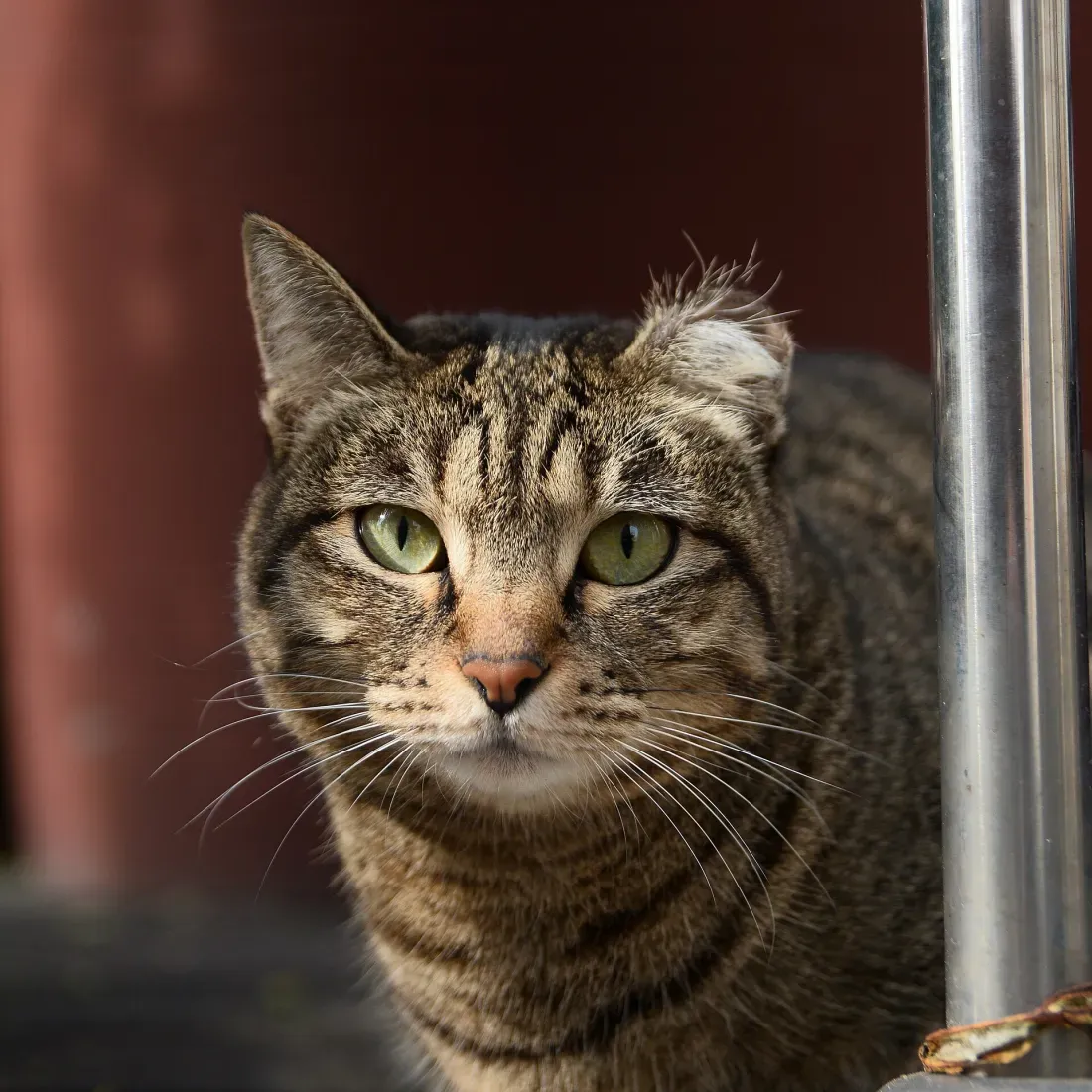 Photo: Yu Tae-wook, CC0, via Wikimedia Commons
You’ll see street cats (길고양이) all over Korea, in alleys, parks and apartment complexes. Seoul estimates it has about 90,000 of them. The city has run a trap-neuter-return program since 2008, and in 2025 local governments across the country neutered more than 128,000 street cats. A cat with the tip of one ear clipped has been neutered and returned. Many are fed by volunteer carers known as “cat moms” and “cat dads” (캣맘, 캣대디), some districts have set up public feeding stations, and many universities have student clubs that look after the campus cats. If you’d like to help, leave them be and support a rescue café instead.
Korea’s closest thing to Japan’s cat islands is Yonghodo, a small island off Tongyeong on the south coast. In September 2023 the city turned the island’s closed elementary school into the Cat School, Korea’s first public cat shelter and adoption center, with room for 120 cats and a book café. Tongyeong now promotes Yonghodo as a “cat island” and held its second Cat Island Day there in August 2026. Ferry times and opening hours vary, so check with Tongyeong’s tourist office before you go.
Raccoon, Meerkat and Other Animal Cafés
Korea once had about 240 cafés where visitors could touch raccoons, meerkats, arctic foxes and capybaras. Since 14 December 2023, the law has banned the display of wild animals anywhere that isn’t a licensed zoo or aquarium. Cafés that already had animals and reported them in time may keep only those animals until 13 December 2027, and visitors may no longer touch, feed or ride them. After that date they must become a zoo or close. Dogs, cats, rabbits, guinea pigs and hamsters aren’t covered, which is why cat and dog cafés carry on as before. If you come across a raccoon or meerkat café, it is one of the last, and the animals can’t be handled.
Whichever city you’re in, a Korean cat café is an easy, inexpensive hour off your feet. Browse all of them on our South Korea cat café map, and if you’re new to the idea, our guide to what a cat café is covers the etiquette in more detail.