Every cat needs to scratch, and if you don’t give it something good to scratch, it will choose for itself, usually the arm of the sofa. The trouble is that many scratching posts end up ignored. In a survey of more than 4,000 owners, 69% of those whose cat scratched the furniture already had a post in the same room. Cats are fussy about height, steadiness and texture, and a short, wobbly, carpeted post fails on all three.
We compared posts and scratchers on height, how stable they are when a cat pulls on them, what they’re covered in, how long they last, and what owners report after months of use. These are the ones we recommend.
- Best overall: the SmartCat Ultimate Scratching Post, a 32-inch sisal post on a wide base, sold since 2004 and still the classic choice.
- Best for large cats: the MidWest Feline Nuvo Grand Forte, a heavy 41-inch post with a thick sisal column, for about $48.
- Best cardboard scratcher: the FUKUMARU L-Shaped Cat Scratcher, which gives a cat an upright surface and a flat one for under $20.
- Best cheap flat pads: the Kitty City XL 3-Pack, double-sided cardboard pads for the rug, the stairs or the bedside.
Why Cats Need a Scratching Post
Scratching isn’t bad behavior. International Cat Care explains that it keeps claws in good condition by pulling off the old outer layer, stretches and exercises the muscles of the front legs and back, and leaves a scent and a visible mark that tell the cat this is home. That’s why cats scratch in prominent places, such as by doors, next to where they sleep, and in the rooms where everyone spends time, rather than in a quiet corner.
So the aim isn’t to stop your cat scratching. It’s to give it a place it prefers to your furniture. If your cat has already picked the sofa, our guide on how to stop a cat scratching furniture walks through retraining it step by step.
What Makes a Good Scratching Post
It’s tall. A cat scratches at full stretch, standing on its hind legs, so the post needs to be at least as tall as your stretched-out cat. Humane World for Animals suggests at least 32 inches (81 cm), and a review in the Journal of Feline Medicine and Surgery suggests at least 3 feet (91 cm). In the owner survey, cats with posts taller than 3 feet were less likely to scratch elsewhere (55% against 65%).
It doesn’t move. A post that wobbles or tips while a cat is pulling on it can scare it off for good. Look for a wide, heavy base, and push the post hard yourself before you trust it. Standing it against a wall helps too.
It’s covered in sisal rope, or cardboard. In the survey, rope was the most popular surface where it was offered, and cats with rope posts scratched elsewhere the least. In a 2022 study of 2,465 owners, giving a cat sisal rope was linked to less unwanted scratching. Corrugated cardboard is the other surface cats love, and it’s cheap. Avoid carpeted posts: San Francisco SPCA warns that looped carpet can snag claws, and a cat that learns to scratch carpet may not see the difference between the post and your rug.
It suits the way your cat scratches. Some cats stretch up a vertical surface, others claw along the floor, and many do both. Watch what your cat scratches now. A cat that goes for the sofa arm needs an upright post, a cat that shreds the rug may prefer a flat pad.
There’s more than one. International Cat Care suggests one scratcher per cat plus one, in different places, and in the 2022 study more posts went with less unwanted scratching.
These studies are based on what owners report and can’t prove cause and effect, but they agree with what vets and behaviorists recommend.
Best Overall: SmartCat Ultimate Scratching Post

Best Overall Scratching Post
SmartCat Ultimate Scratching Post
A 32-inch (81 cm) post covered in woven sisal fabric on a 16 by 16 inch (41 by 41 cm) base. Assembles with two screws. More than 34,000 ratings on Amazon, averaging 4.7 stars.
Buy on AmazonThe SmartCat Ultimate is the post we’d buy first, and the one in our adoption checklist. It has been on sale since 2004 and has more than 34,000 ratings on Amazon, averaging 4.7 stars, which is remarkable for something so simple.
It gets the basics right. At 32 inches (81 cm) it’s tall enough for most cats to stretch out fully, and the wide 16-inch (41 cm) square base stops it tipping when a cat hangs off the top. The post is covered in woven sisal fabric rather than rope, a tough, rough surface that cats can sink their claws into, and that wears slowly. It comes in beige or gray and costs about $70.
Good to know:
- The sisal sheds a little at first and looks shredded after heavy use. That’s a sign your cat loves it, so don’t swap it out too soon.
- It’s a plain post with no toys or perches. If your cat likes to climb and sit up high too, look at a cat tree instead.
- A very long cat may want something taller, like our next pick.
Best for Large Cats: MidWest Feline Nuvo Grand Forte
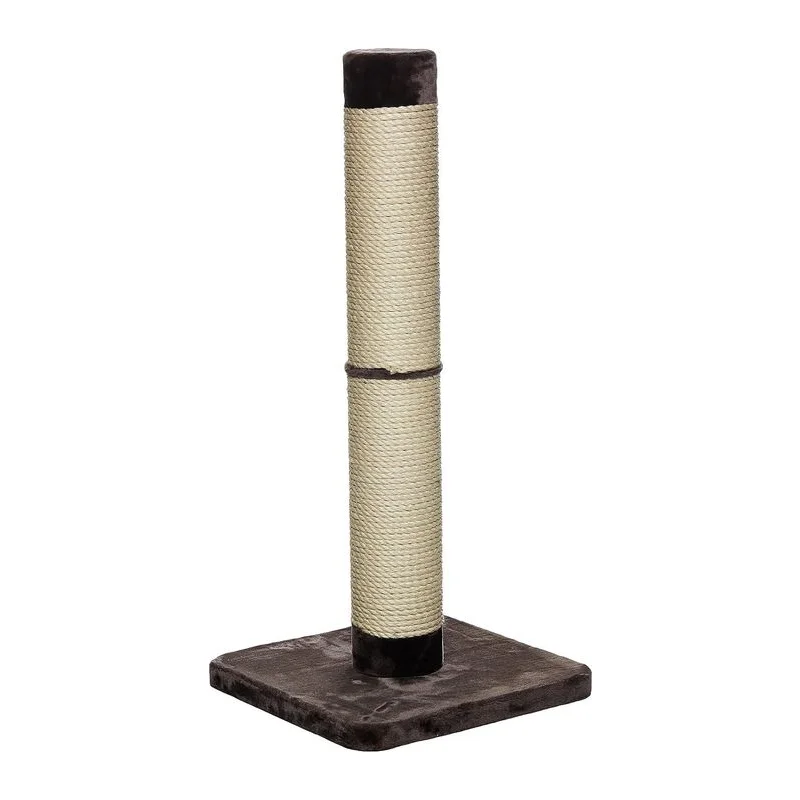
Best Scratching Post for Large Cats
MidWest Feline Nuvo Grand Forte
A 41-inch (104 cm) post with a thick column wrapped in natural sisal rope, on a 19 by 19 inch (48 by 48 cm) base covered in faux fur. Weighs about 19 pounds (9 kg). Rated 4.8 stars on Amazon.
Buy on AmazonFor a Maine Coon, a big rescue tom or a cat that stretches out long, the MidWest Feline Nuvo Grand Forte is the post to get. At 41 inches (104 cm) it’s well over the 3 feet the review recommends, and it weighs about 19 pounds (9 kg) on a 19-inch (48 cm) square base, so even a heavy cat can throw its weight into it without it rocking.
The column is extra thick and wrapped in natural sisal rope, the surface cats used most in the owner survey, and the base and top are covered in soft dark faux fur. It has a 4.8-star average from more than 2,000 ratings, and at about $48 it costs less than the SmartCat.
Good to know:
- It’s big. Make sure you have a 19-inch (48 cm) square of floor for it, ideally against a wall or next to the furniture your cat already scratches.
- The faux fur picks up cat hair. Spot clean it with mild soap.
Best Cardboard Scratcher: FUKUMARU L-Shaped Cat Scratcher
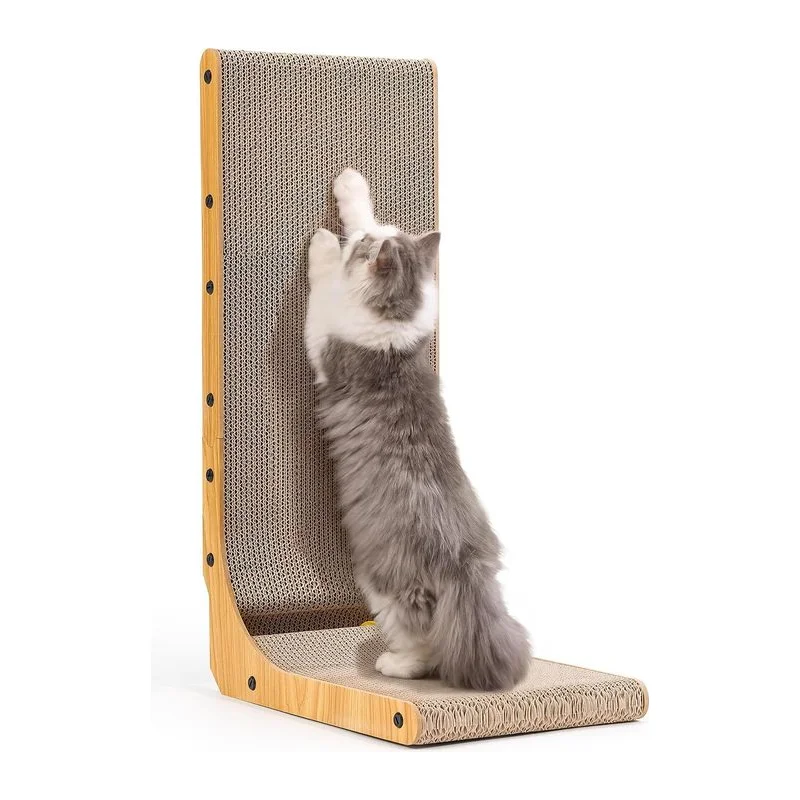
Best Cardboard Scratcher
FUKUMARU L-Shaped Cat Scratcher
An L-shaped corrugated cardboard scratcher, 26.8 by 16.6 by 11.5 inches (68 by 42 by 29 cm), with 1.6-inch (4 cm) thick cardboard. Stands upright against a wall, or lies flat as a scratch pad and lounger. More than 18,000 ratings on Amazon.
Buy on AmazonCardboard is the cheapest surface cats love, and the FUKUMARU L-Shaped Cat Scratcher gets more out of it than a flat pad. Its L shape gives a tall back, about 27 inches (68 cm), and a flat base, so a cat can scratch standing up against the back, scratch along the bottom, or curl up in the corner. Stand it against a wall, or the side of the sofa, and it doesn’t slide about the way a loose pad does.
The cardboard is 1.6 inches (4 cm) thick, which FUKUMARU says is thicker than most L-shaped scratchers, and it comes with a ball toy. It has more than 18,000 ratings on Amazon and costs about $19 in the 26.8-inch size. FUKUMARU also sells smaller and taller sizes, and two- and four-packs.
Good to know:
- Cardboard sheds bits as it wears, so expect some crumbs around it, and it will need replacing sooner than a sisal post.
- At 27 inches it’s shorter than a proper post, so for a big cat use it alongside one, not instead.
- Cardboard is a good first scratcher for a kitten. In a small study of 8-week-old kittens, curved cardboard was far more popular than a rope post.
Best Cheap Flat Pads: Kitty City XL 3-Pack
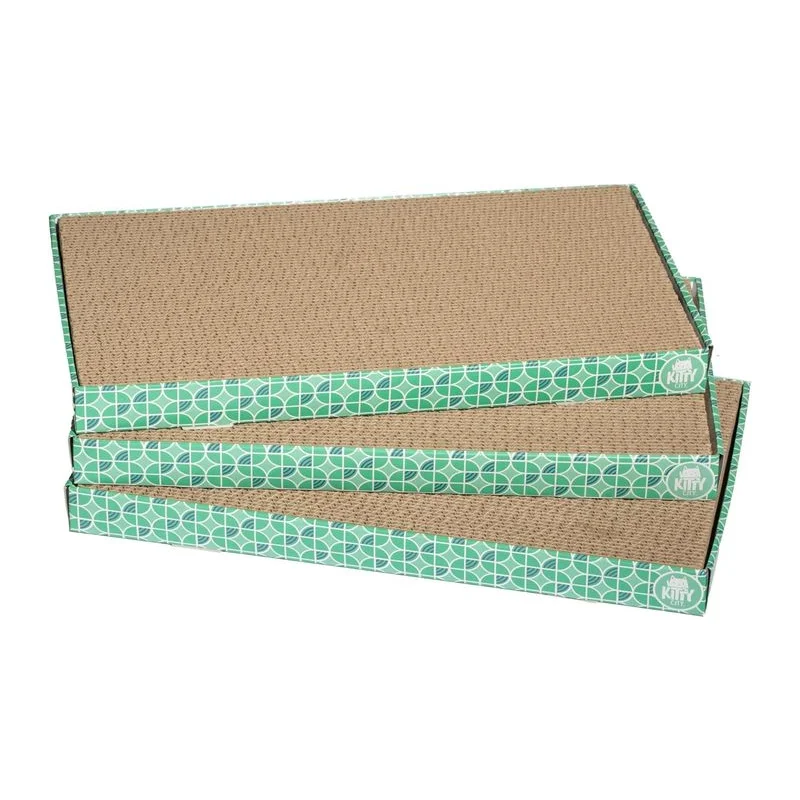
Best Cheap Flat Scratchers
Kitty City XL Cardboard Scratcher Pads
A pack of three 10 by 18 inch (25 by 46 cm) corrugated cardboard pads, usable on both sides. They wear out, but they cost little to replace. More than 21,000 ratings on Amazon, averaging 4.7 stars.
Buy on AmazonFlat pads like the Kitty City XL are the cheapest way to put a scratcher everywhere your cat might want one: by the bed, at the bottom of the stairs, on the rug it keeps clawing, or next to the door. You get three double-sided pads for about $18, and when one side is worn you flip it over. They have more than 21,000 ratings on Amazon, averaging 4.7 stars.
They’re also a cheap way to find out whether your cat prefers to scratch flat or upright before you spend money on a big post.
Good to know:
- A light pad can slide when a cat digs in. Put it against a wall or on a rug, or tape it down.
- Pads don’t give a full stretch, so they don’t replace a tall post. Use them as extra scratchers.
Where to Put a Scratching Post
Where the post goes matters as much as which one you buy. A good post in a spare room will be ignored.
- Next to the spot your cat already scratches. If it’s the sofa, the post goes right against the sofa arm. Humane World for Animals says location is key.
- Near where your cat sleeps. International Cat Care notes that cats often scratch close to their sleeping places.
- In the main rooms and by doorways. Scratching is partly a way of marking territory, so cats choose places that matter, not hidden corners.
- On a hard floor or against a wall, so it doesn’t move.
Once your cat uses a post every day you can move it, slowly. The Indoor Pet Initiative at Ohio State suggests no more than three inches a day (about 8 cm).
How to Get Your Cat to Use It
- Make it interesting. Drag a wand toy up and over the post so your cat digs in its claws to catch it.
- Try catnip or silver vine. In a study of 100 cats, 79% responded to silver vine and 68% to catnip, and most cats that ignored catnip responded to silver vine. Rub a pinch into the post.
- Reward it. Give a treat or praise every time your cat scratches the post. In the owner survey, 80% of cats that were rewarded used their post every day, against 68% of those that weren’t.
- Don’t force it. Holding your cat’s paws against the post can frighten it and put it off the post.
- Leave the old one. A shredded post smells of your cat and is the one it trusts. Add a new post next to it before you throw the old one out.
If your cat still prefers the sofa, our guide on how to stop a cat scratching furniture covers guards for the furniture, what to avoid, and when scratching is a sign of stress. Keeping claws short helps limit the damage while your cat learns: see how to trim a cat’s nails.
What About Wall-Mounted and Hanging Scratchers?
Scratchers that hang on a door or screw to the wall save floor space, but they’re a gamble. In the owner survey, cats with wall-mounted scratchers were the most likely to scratch elsewhere (74%). A hanging scratcher that swings or rattles when a cat pulls on it can put a cat off, just like a wobbly post. If space is tight, a cardboard scratcher leaned against the wall, like the FUKUMARU, is a safer bet.
How to Choose
For most cats, get the SmartCat Ultimate. It’s tall, steady and covered in sisal, and it lasts for years. If your cat is large or long, or you’d like a taller post for less, the MidWest Grand Forte is the better buy. Add a cardboard scratcher like the FUKUMARU for cats that like to scratch low or lounge, and a pack of Kitty City pads to put wherever your cat scratches next.
Whatever you choose, buy more than one, and put them where your cat already wants to scratch. If your cat also likes to climb and keep watch from up high, see our guide to the best cat trees.